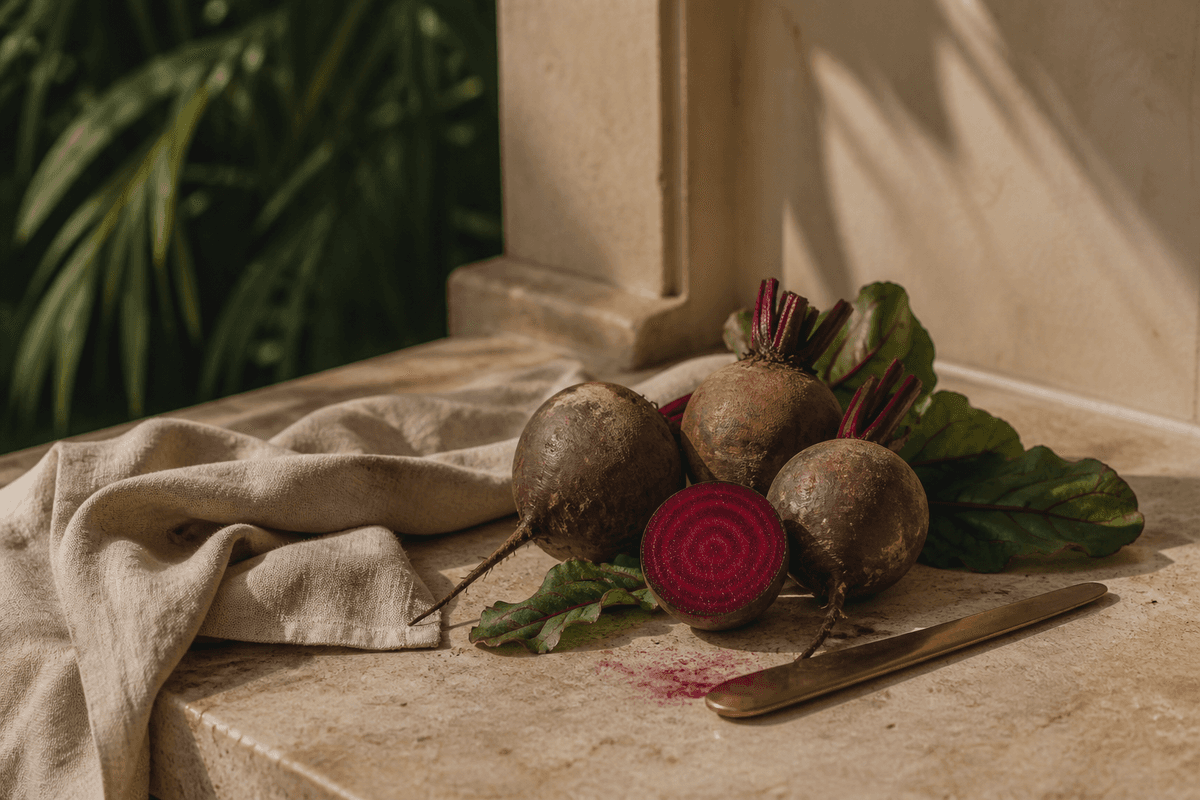
Halve a beetroot and it bleeds. The colour comes up on the board, the fingers, the linen — a red so saturated it reads less like a vegetable than a mineral, or a wound. Nothing else in the crisper drawer announces itself quite this way.
Beetroot is the cultivated taproot of the sea beet, a wild plant of the Mediterranean coast that people first grew not for the root at all, but for its leaves; the Romans were the first to prize the swollen red root beneath [1]. Ever since, it has been read as two things at once — dinner and medicine, pigment and tonic. What follows is that root, held up to two lights: the classical Chinese physician's, and the modern Western laboratory's. They agree more than you would think.
A root with two passports
The sea beet still grows along the shingle of Europe's coasts, its leaves glossy with salt. Domesticated across the ancient Near East and Mediterranean, it was a leaf crop for centuries — the same lineage that gave us chard — before Roman gardeners coaxed the root into something worth eating [1].
The ancients did not treat it lightly. Roman writers recorded the beet as a food of love, and later lore made it Aphrodite's secret for staying beautiful; the Greeks are said to have offered it at the temple of Apollo at Delphi, its worth reckoned in silver [2]. Whether or not the silver is true, the reputation is the point: to the people who grew it, this was never a humble root.

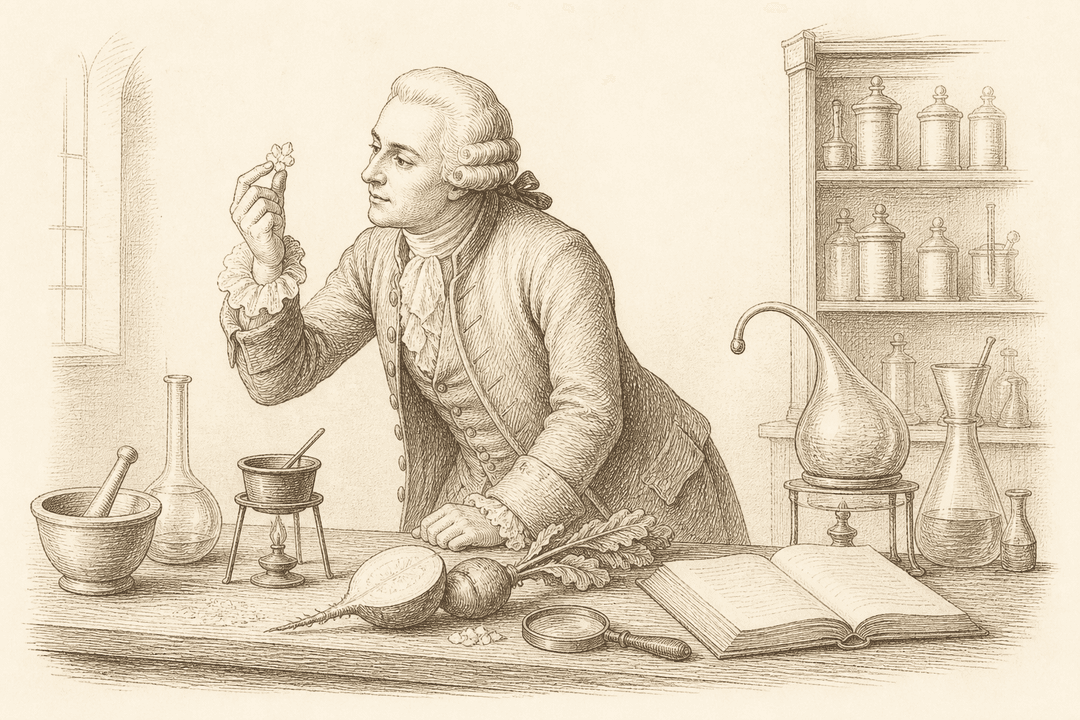
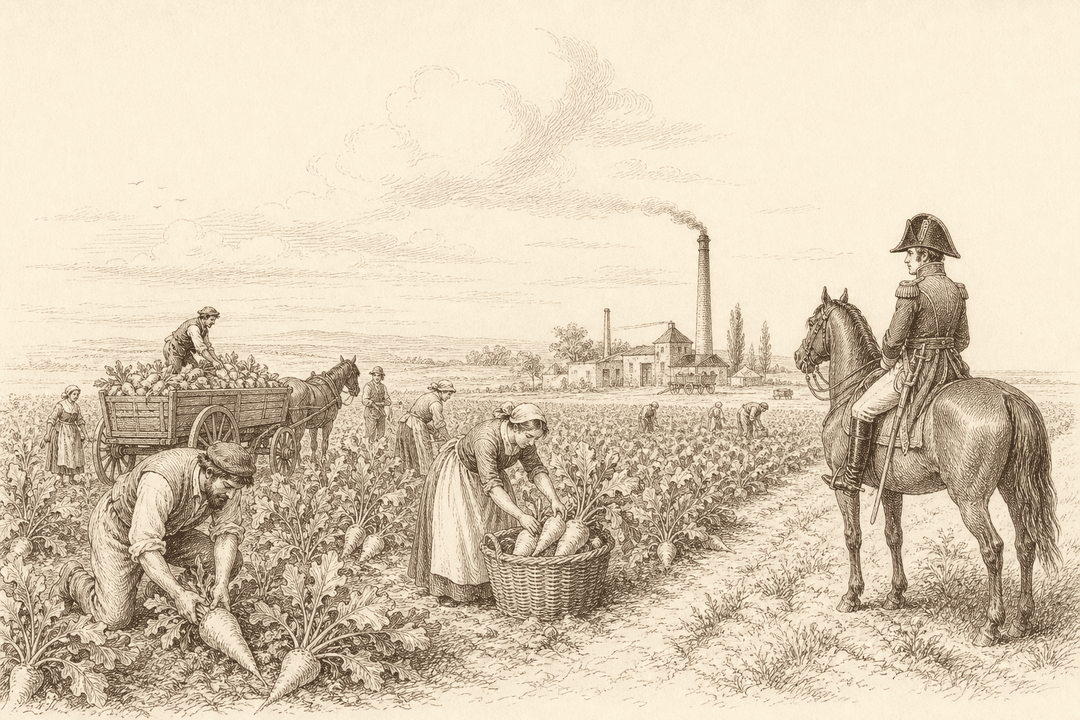
Its second life was industrial. In 1747 the Berlin chemist Andreas Marggraf drew sugar crystals from a pale beet and found them identical to cane sugar; when Napoleon's blockade later cut Europe off from Caribbean cane, the sugar beet became a strategic crop almost overnight [3].
One plant, bred one way for the table and another for the sugar bowl.
And then there is the soup. Across Eastern Europe, beetroot became borscht — a dish so bound up with identity that UNESCO placed the culture of Ukrainian borscht cooking on its heritage list in 2022 [4]. The famine root of hard winters had become an inheritance worth safeguarding.
From Kyiv to Shanghai, in one bowl
Beetroot reached the modern Chinese table by a route worthy of a novel. After the October Revolution, White Russian émigrés fled east and settled in Shanghai — and they brought borscht with them. Shanghai's pidgin ear turned "Russian soup" into what is still called luósòng tāng (罗宋汤), and local cooks, finding the Russian version too sour, sweetened it into something of their own [5].
So the red root we know arrives in Chinese cooking carrying a passport stamp from Kyiv by way of Moscow. But the plant itself is a far older resident of China than its soup — and the reading it was given the first time is the one worth returning to.
The Chinese reading: a plant, read by its nature
Long before the Russians brought the red root east, the beet had already lived in China for a millennium — arriving around the fifth century as a leaf vegetable, carried along the trade roads from the Middle East [7]. It entered the medical record not for its colour but for its character. In the classical pharmacopoeia it is the leaf beet (菾菜), a name drawn from the word for sweet. The sixth-century Records of Famous Physicians set it down, the Tang dynasty's official Newly Revised Materia Medica confirmed it, and in 1578 the physician Li Shizhen gathered their readings into his Compendium of Materia Medica (本草綱目), the great pharmacopoeia of Chinese medicine [6].
Their verdict was exact and unanimous: sweet, and profoundly cooling (甘, 大寒). A plant to drink against seasonal fever, to clear what they called wind-heat toxin, taken as a pressed juice [6]. This is the older, quieter tradition at work: not the modern fashion of crowning a red root a blood-building tonic (补血) for the colour of it [8], but centuries of physicians reading a plant by its nature and writing down, plainly, what it did.
Hold on to that one word — cooling. It is about to meet its match.
The Western reading: nitrate and pigment
The Western laboratory arrives at the same root from the opposite end, and confirms the old reading almost to the letter. Beetroot is one of the richest dietary sources of nitrate, and the body puts that nitrate to work.
Through the nitrate–nitrite–nitric-oxide pathway, it becomes nitric oxide — the molecule that signals the walls of the blood vessels to relax and open. Blood moves more freely; blood pressure comes down [9]. Now set the two traditions side by side. The Tang physicians called it profoundly cooling — a coolant that opens and calms. Modern pharmacology calls it a vasodilator that lowers pressure. Five centuries and a continent apart, they reached the same verdict: this root cools and opens; it does not drive and heat.
It is why endurance athletes drink beet juice before a race. The science of nitrate and stamina is genuine — and refreshingly honest about its scale: the gains are real but measured, not miraculous [10]. A true effect rather than a marketed one, which is rarer than it sounds.
The colour that stains everything
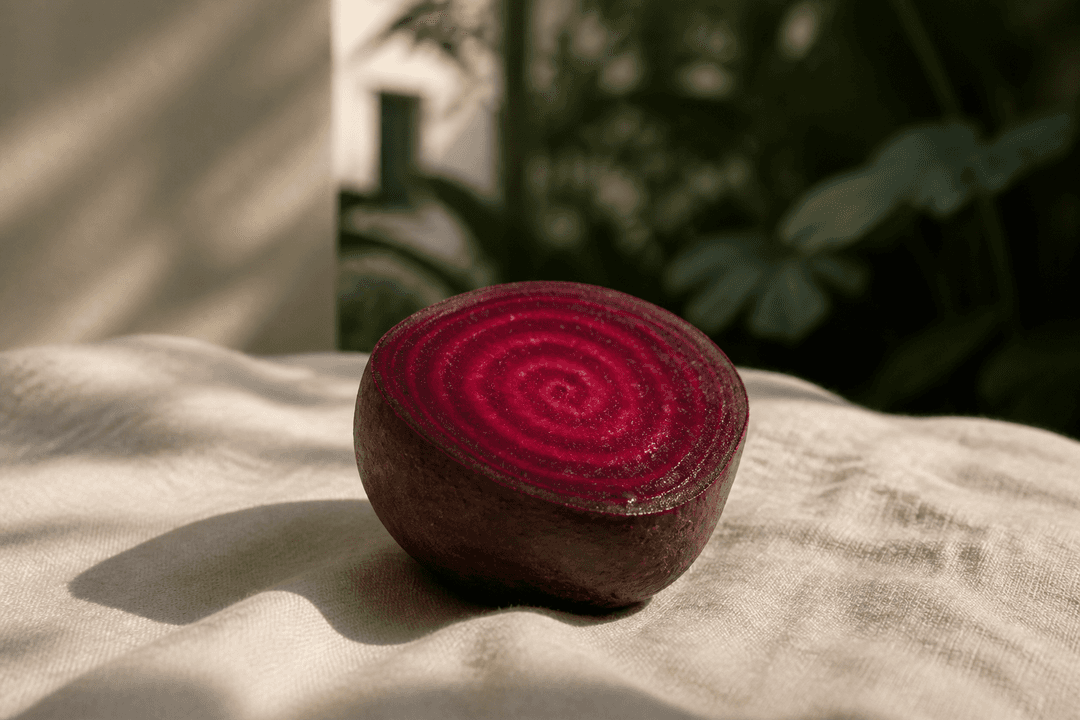
That impossible red has a name: betanin, a pigment of the betalain family, and one of the most vivid colours in the plant kingdom [12]. It is a genuine antioxidant, and stable and gentle enough that the food industry borrows it as a natural dye — listed as E162, "beetroot red" — to colour everything from yoghurt to confectionery [12].
The pigment is also why beetroot behaves like ink. It bleeds into whatever it touches, shifts from crimson to violet as acidity changes, and in about one person in eight it passes through the body still coloured, tinting the day's water a startling rose. The condition has a name — beeturia — and it is entirely harmless, however unnerving it looks the first time [11].
Even the flavour is elemental. Beetroot's earthiness is geosmin, the very compound your nose reads as soil after rain — petrichor, folded into a root, detectable at a few parts per trillion [13]. To eat beetroot is, in a small way, to taste the ground it grew in.
Glow from within, read honestly
"Glow from within" is one of beauty's oldest promises, and beetroot is where two threads of it draw together. Betanin is an antioxidant [12]. And the nitrate that feeds the nitric-oxide pathway governs circulation — the same nitrate that turns out to be stored in the skin itself, several times more concentrated in the dermis than in the blood [9].
Read plainly, without the halo: a glow is largely good circulation and a well-fed complexion. Beetroot speaks to both — the colour and the flow. That is the honest shape of "drink your skincare": not a modern invention, but an old idea the root has always carried in one ruby package.
Where this leaves the root
Two traditions, five hundred years and half a world apart, read beetroot and came back with the same answer. The materia medica read its nature; the laboratory read its chemistry; both called it a coolant that opens the blood. The ruby colour was the clue all along.
This is the root at the heart of our own ruby pour, Model Glow — beetroot pressed cold with pineapple and apple, and named, with a small wink, for that oldest promise.
What we offer is only the pleasure of it: the cold, the colour, the earthy-sweet first sip. Keep one in the door of the fridge and let it be what beetroot has always been — sweet, cooling, deeply cultured — and a good reason to slow down on a Sunday and look, for a moment, at the colour of it before you drink.


