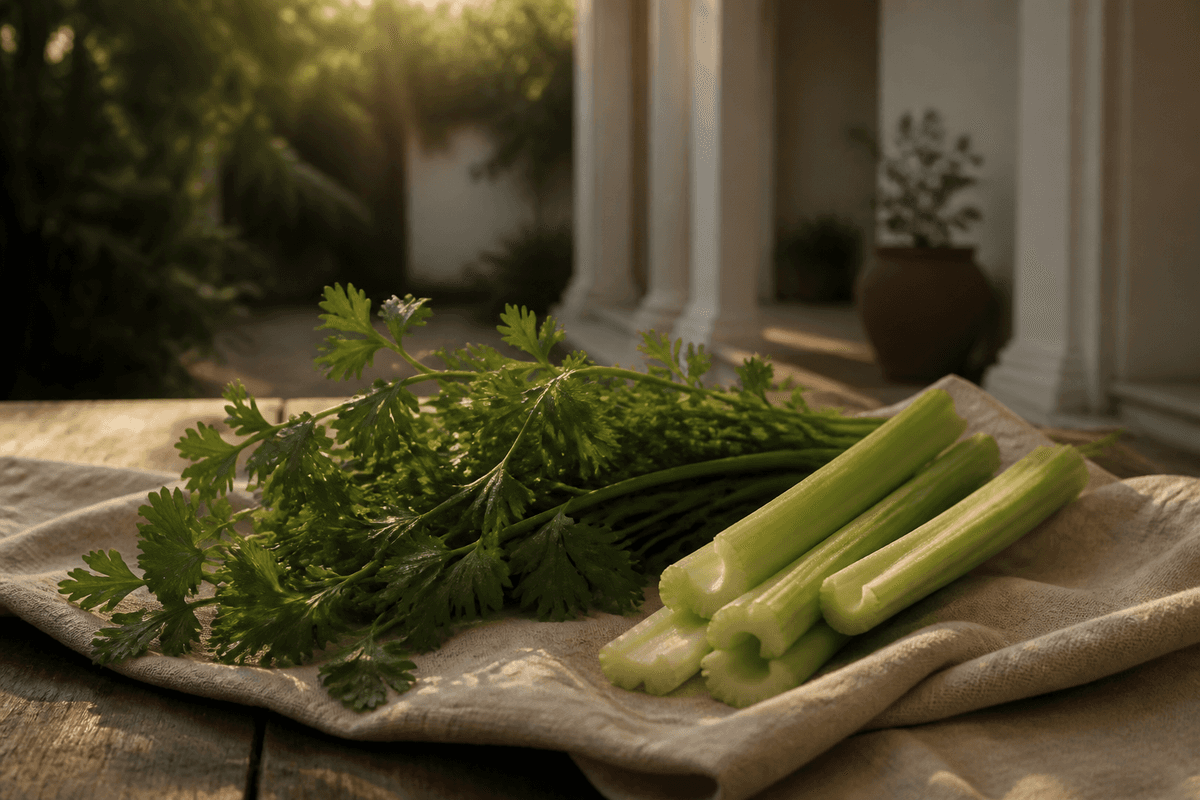
Snap a stalk of celery and the whole kitchen knows. There is no colour to announce it — celery is the palest thing in the crisper drawer, all water and pale-green ribs — so it announces itself by smell instead: green, saline, faintly medicinal, the scent of a soup about to begin. Hold on to that smell. It is the thread that runs through everything that follows — the crown, the grave, and the medicine.
Celery is the cultivated form of a wild marsh plant of the Mediterranean coast, grown for ceremony and physic long before anyone thought to eat the stalk [6][7]. To the Greeks it was selinon, a sacred green; to the classical Chinese physician it was 芹 (qín), a plant to be read by its cooling nature; to the modern laboratory it is a quiet source of nitrate and of one particular molecule that would, in the end, become a medicine. Three traditions, one plant, and — as with the best of them — a single verdict.
The green that crowned both victors and the dead
No plant in antiquity carried a stranger double life. Wild celery was the wreath of triumph and the wreath of mourning at once.
Homer set it in paradise. In the fifth book of the Odyssey, when Hermes comes to Calypso's island, the meadows around her cave are blooming with violets and with selinon — wild celery, growing in the garden of a goddess [1].
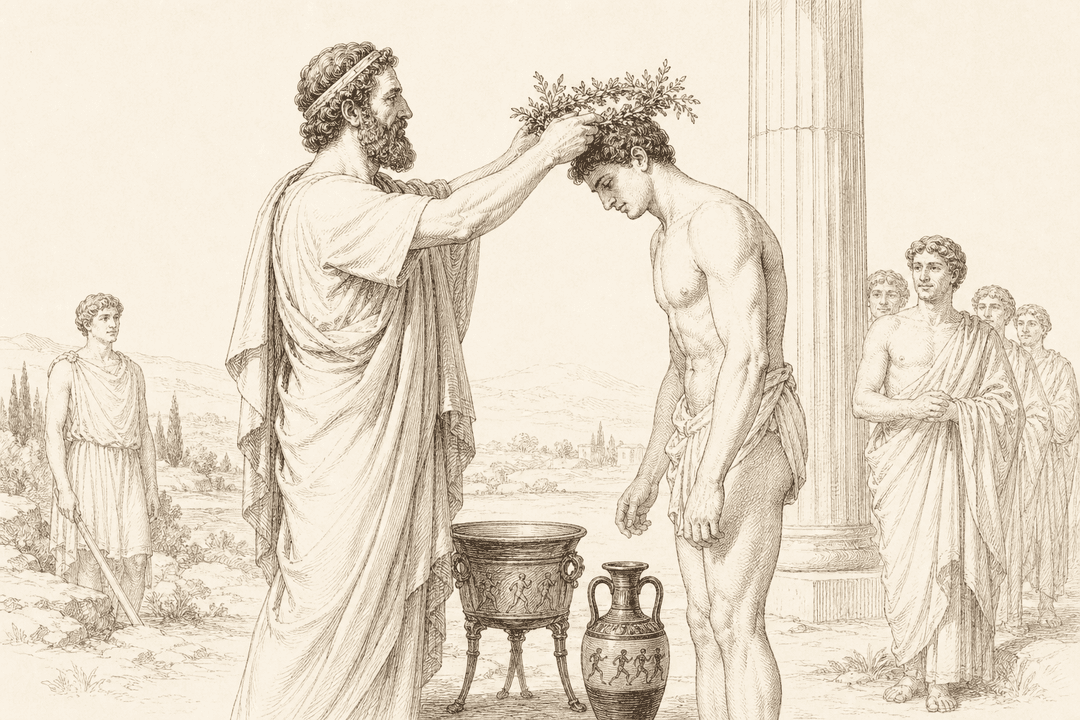
On earth it crowned champions. At the Nemean and Isthmian Games — two of the four great sacred contests of Greece — the victor was given not gold but a wreath of wild celery, plucked fresh from the riverbank, exactly as Olympia gave olive and Delphi gave laurel [3][4].
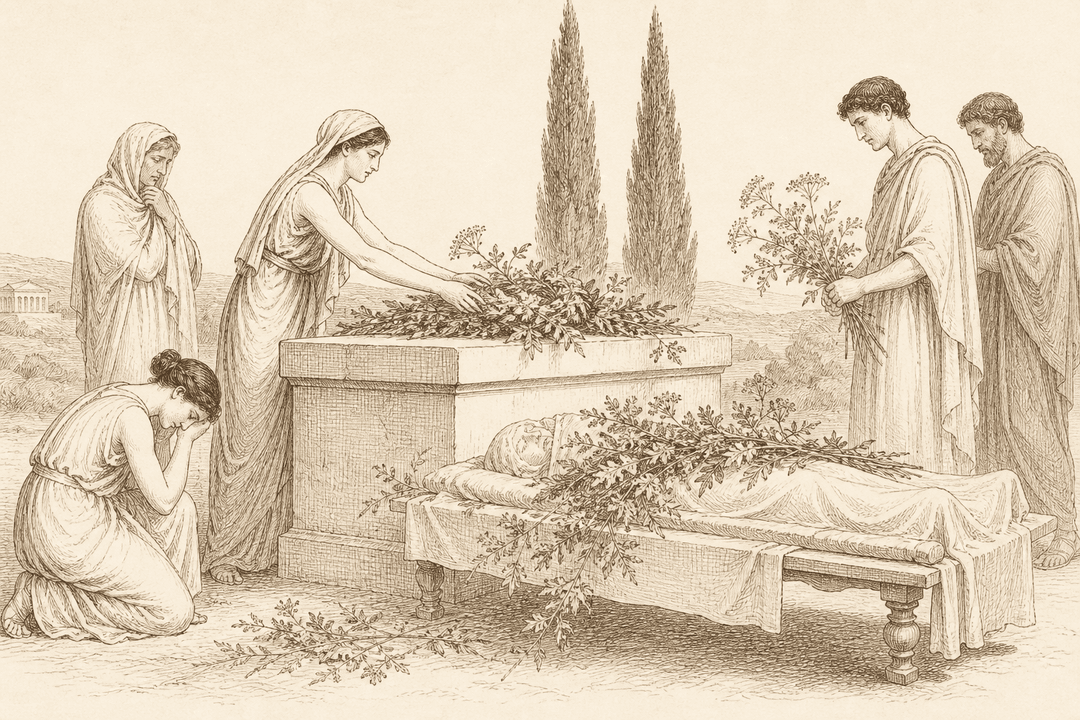
And yet the same green wreathed the dead. Its dark leaves and heavy scent struck the Greeks as chthonic — belonging to the underworld — so celery was laid on graves and woven into funeral garlands, and to say that a gravely ill man "had need only of selinon" was to say he was as good as buried [3].
Plutarch caught both meanings colliding in a single afternoon. Marching to face the Carthaginians in Sicily, Timoleon's Corinthian soldiers met a train of mules loaded with celery — "the herb with which we not unfrequently adorn the sepulchres of the dead" — and read it as an omen of their own graves. Their general turned it over like a coin: this same celery, he reminded them, is the victor's crown at the Isthmian Games. He wove himself a wreath of it, his captains followed, and an army walked into battle wearing the plant of the grave as a garland of victory [2]. The Egyptians had reached for it in the same spirit long before: among the cornflowers and olive leaves of the floral collars laid on Tutankhamun's coffins, the embalmers had woven wild celery — a green offering for the journey out, still identifiable after more than three thousand years [5].
From sacred weed to the salad plate
For most of its history celery was flavour and physic, not food. The plant the Greeks called selinon became the Romans' smallage, the Old French céleri, and at last the English "celery," a word first written down in 1664 [6]. What we crunch today is a latecomer: the mild, blanched, watery stalk was bred only in the last two or three centuries, coaxed by gardeners out of a bitter marsh herb that earlier cooks used as sparingly as a bay leaf [6][7]. That restraint is why celery still sits at the base of Western cooking — one third of the mirepoix, the onion-carrot-celery trinity that begins a stock or a ragù. It was never meant to be the star. It was meant to be the ground the flavour stands on.
The Eastern reading: a plant read by its nature
China prized celery early and openly. The Book of Songs, the oldest anthology of Chinese verse, opens a hymn to a lord's academy with scholars gathering 芹 from its waters — the image that made "plucking celery" (采芹) a byword, for two thousand years after, for a scholar's first success [9]. Li Shizhen would later quote an older line still, that "the celery of Yunmeng" ranked among the finest vegetables under heaven [8].
When the physicians came to read it, they read by nature, not by fashion. In 1578 Li Shizhen gathered a millennium of pharmacy into his Compendium of Materia Medica (本草綱目), and set celery down under its old name 水斳 (water celery): sweet and neutral — some said bitter, sour and cooling — and taken, tellingly, as a pressed juice [8]. Its work, the text records, was to "protect the blood vessels" (保血脈), to augment the qi, and, drunk as that juice, to "clear the wind-heat from the head" (去頭中風熱) — the classical language for exactly the pounding, flushed, dizzy head we would now call high blood pressure [8].

Li Shizhen was careful to name two celeries: water celery, and the land celery (旱芹) of dry fields — the aromatic Apium graveolens of our own kitchens. It is that land celery the later tradition reads most sharply: cooling, and a calmer of the liver (平肝) — the organ Chinese medicine holds responsible for the rising heat of headache and vertigo — and, in plain modern words, a lowerer of blood pressure [10].
The Western laboratory reaches the same verdict
The modern reading comes at celery from the opposite end and lands in the same place. The plant's medicine, it turns out, is hidden in its smell.
That unmistakable green, savoury scent is a family of compounds called phthalides — chief among them 3-n-butylphthalide, the molecule that makes celery smell like celery [12]. And phthalides relax the smooth muscle in the walls of the blood vessels, behaving rather like a gentle calcium-channel blocker, so the vessels widen and the pressure inside them eases [12]. Celery is also, like beetroot, a natural store of dietary nitrate, which the body converts into vessel-opening nitric oxide [14]. The scent the Greeks called chthonic is, molecule for molecule, a mild antihypertensive.
The science is real, and honest about its scale. A 2025 review of controlled trials found celery lowered both systolic and diastolic blood pressure — a modest reduction, the authors are careful to say, but a clinically useful one, since even a sustained two-point drop in systolic pressure lowers the risk of stroke by around six per cent [13]. A true, measured effect, which is rarer and worth more than a marketed one.
The seed that became a stroke medicine
Then there is the coda the old physicians could not have written, yet somehow anticipated. Celery seed had been used in China for centuries against headache, dizziness and what we now call hypertension [11]. In the late 1970s, Chinese chemists isolated the seed's principal phthalide — L-3-n-butylphthalide — and by 1980 had synthesised it [11]. In 2002, China's drug authority approved it, as dl-butylphthalide, as a front-line treatment for ischaemic stroke, where it shields the brain's small vessels [11].
Read that sequence slowly. A seed used for centuries against the dizzy, aching head became, in our own lifetime, an approved medicine for the stroke that a dizzy, aching head can foretell. The Ming physician and the modern pharmacologist were reading the same plant — five hundred years apart, and arriving, once again, at the same verdict.
The smell, the salt and the Singapore table
Celery earns its keep by that scent everywhere it travels. The Romans smelled strength in it — the botanical name graveolens is simply Latin for "strong-smelling." Modern food factories smell insurance: celery is so rich in natural nitrate that its cultured juice and powder are what "cure" the "uncured," no-nitrate-added bacon on the shelf, the plant quietly doing the preserving a synthetic salt would otherwise do [14].
Nowhere is the scent more at home than on the Chinese table. Chinese celery (芹菜) — the slender, hollow-stalked, ferociously fragrant cousin of the fat Western stick — is a seasoning, not a salad: a fistful thrown into a wok of clams, scattered raw over a bowl of fish soup or porridge, simmered into a pot of bak kut teh until the broth turns green at the edges [6]. Here celery has never pretended to be the main event. It is, as it was for the Greeks, the thread that makes everything around it smell alive.
The miracle and the plant
Which brings us, gently, to the miracle. In recent years celery has been sold as a morning cure — a glass of cold-pressed juice promised, by an author with no medical training and a source he describes as a spirit, to undo everything from fatigue to autoimmune disease [15]. There is no clinical evidence for any of it [15].
The pity of the fashion is that it buries the truth, which is quieter and far more interesting. Celery does not need the miracle. It has three thousand years of being crowned onto victors and laid upon the dead, a Ming physician's note that its juice clears the heat from an aching head, and a molecule drawn from its seed that now guards the human brain. The real plant — mineral-clean, honestly tested — was always the better story than the invented one.
Where this leaves the stalk
Selinon crowned the living and shrouded the dead; 水斳 protected the blood vessels; the laboratory found the antihypertensive folded into the smell. Three readings, three thousand years, one green, saline verdict — a coolant that calms and opens, hidden all along in a plant too pale to look like much.
That is the whole of it in our smallest bottle, the Celery Shot — fifty millilitres of nothing but cold-pressed celery, green and clean and briskly savoury, gone in a single tilt.
What we offer is only the pleasure of it: the cold, the clean green bite, the good sharp smell of a plant that has been quietly worth knowing for three thousand years. Keep one in the door of the fridge, and let celery be what it has always been — the sacred weed, hiding its medicine in plain sight.


