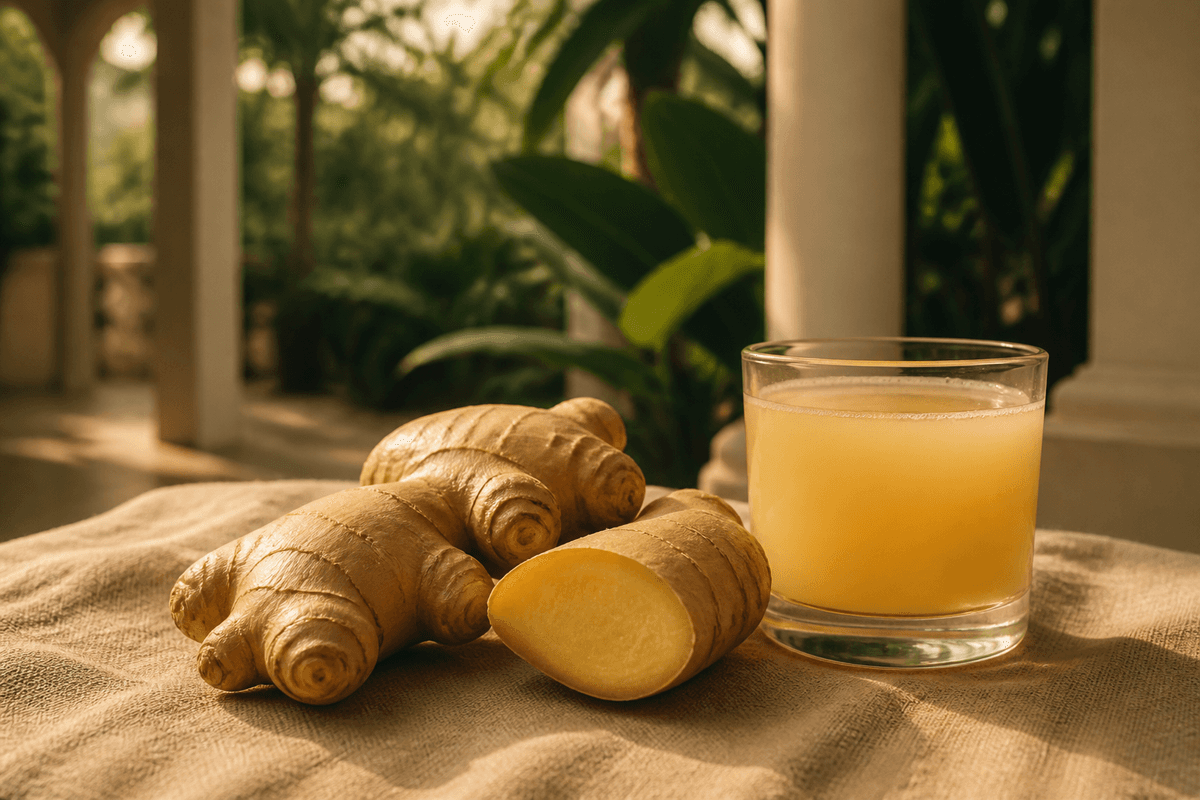
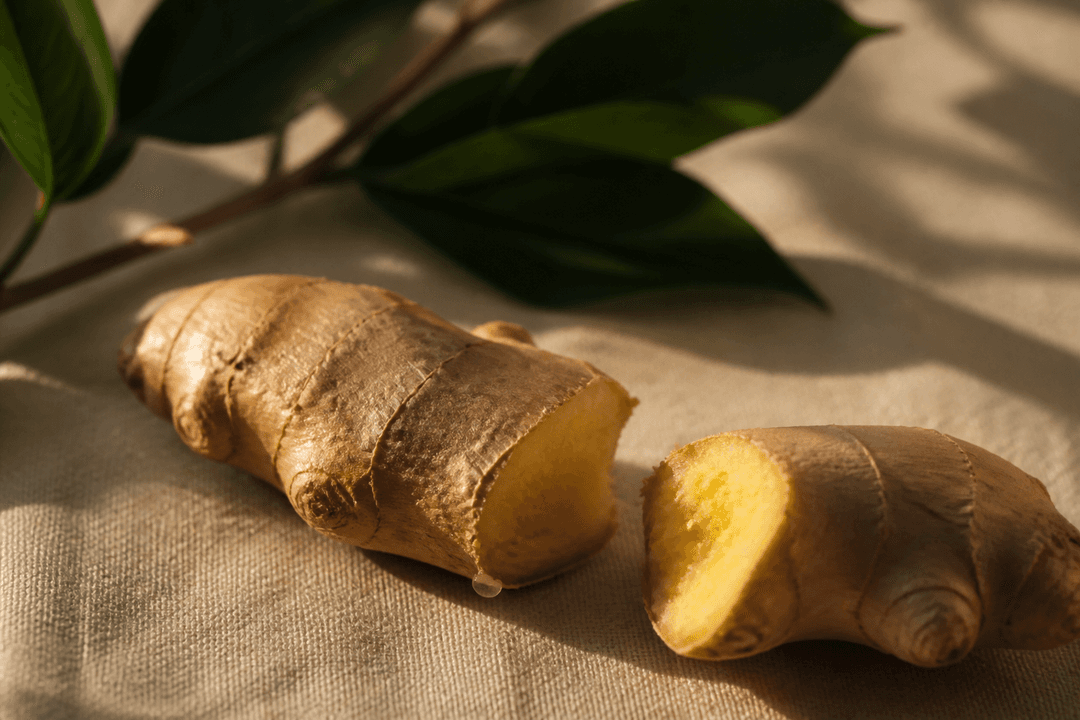
Snap a knob of fresh ginger and it does not so much bleed as breathe. A clean, hot fragrance lifts off the break — citrus, pine, pepper, something almost medicinal — and the pale-gold flesh, fibrous as young wood, wets the fingers with a juice that bites a beat later on the tongue. Beetroot announces itself in colour and turmeric in stain; ginger announces itself in heat.
Ginger is the rhizome of Zingiber officinale, a plant so long in human hands that it no longer grows wild anywhere on earth — every root traces back to one a grower chose, propagated by cutting rather than seed [1]. For at least three thousand years it has been read as several things at once: spice, warmth, medicine, and — the thread through every tradition that ever met it — the remedy for a stomach that will not settle. What follows is that root, held to the light of four traditions. On one point, remarkably, they all agree.
The root that never grew wild
Ginger is Austronesian by birth, first cultivated in Maritime Southeast Asia — the tropical arc of today's Indonesia, Malaysia and the Philippines — and carried across the Indian and Pacific oceans by the seafaring peoples who domesticated it, so early and so completely that no wild ancestor survives [1][2]. It is, in the truest sense, a plant made by human hands.
Its name carries the same voyage. The Sanskrit shringavera — read by later scholars as "horn-root", for the antler shape of the rhizome — became the Greek zingiberis, then Latin, then our own ginger; the deeper root may be the older Dravidian inji-ver, simply "ginger-root", from the Tamil coast the Greeks traded with [3]. The word itself is a spice route, written down.
And in our corner of the world it needs no translation. In Malay it is halia — the warmth steeped through bak kut teh, the fire of ginger and spring onion over steamed fish, the tea a grandmother brews for a queasy child. Long before "warming foods" became a wellness phrase, the warming root was simply dinner.
Confucius kept it at his table
The oldest written word on ginger is not a physician's but a philosopher's. In the Analects, compiled around the fifth century BCE, the disciples record Confucius's habits at the table with great care — and among the notes on how he ate sits a small, exact line: 不撤姜食,不多食 — "he was never without ginger when he ate, though he did not eat much of it" [4].
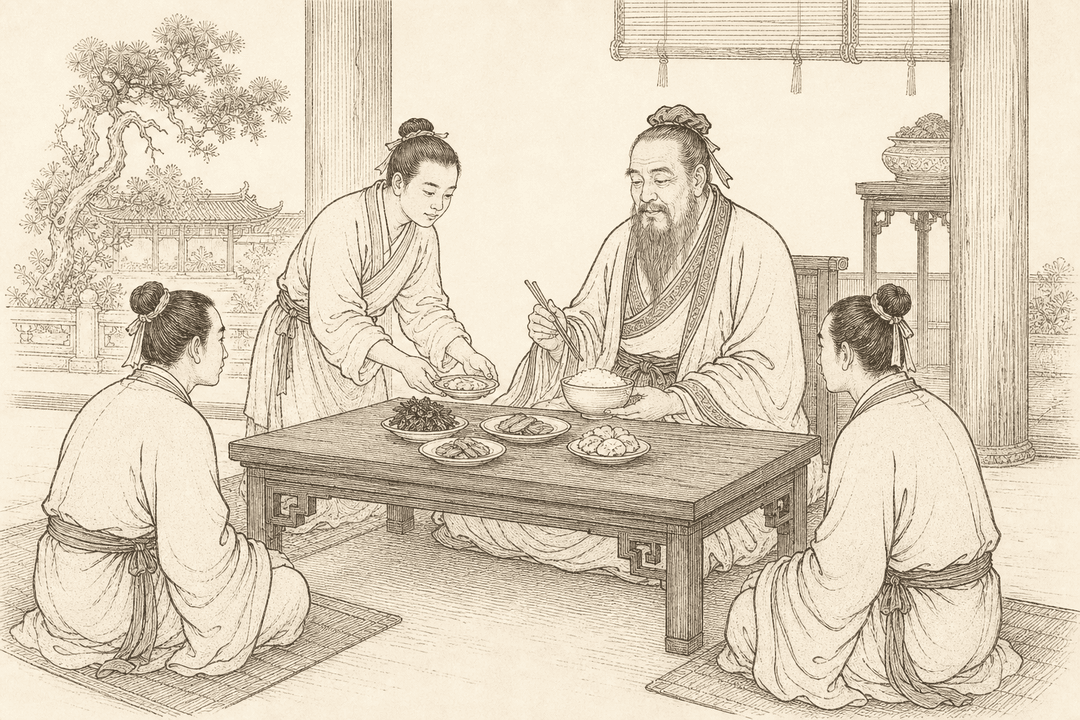
Two and a half thousand years ago, the most influential man in Chinese history kept ginger at every meal — and, in the same breath, counselled restraint. It is the whole modern conversation about the root settled in eight characters: take it daily, take it as food, and do not overdo it.
Worth its weight in a sheep
From that heartland ginger travelled further and earlier than almost any spice. By the first century it was reaching Rome, shipped up the Red Sea and taxed as a luxury at the customs house of Alexandria; the Greek physician Dioscorides, writing his De Materia Medica around 70 CE, set it down as a root that "warms and softens the stomach" and quickens the digestion [5][8].

By the Middle Ages it was Europe's second spice after pepper, and priced like treasure: in fourteenth-century England a pound of ginger cost about a shilling and sevenpence — near the price of a whole sheep — and gingerbread, pressed into gilded shapes, marked a place at a royal table [5]. When the Spanish reached the New World they carried the root with them; ginger was planted in Jamaica by about 1525, and within a generation the island was shipping it back across the Atlantic by the thousand tonnes — the first Asian spice successfully transplanted to the Americas [9]. A root with no wild home had made itself at home on every continent.
Many tongues, one verdict
Everywhere it went, ginger was read the same way — and the readings are worth setting side by side, because they were written centuries and oceans apart.
The Chinese verdict is the oldest and most exact. The Divine Farmer's Classic of Materia Medica (神農本草經), set down in the Han dynasty, lists dried ginger (干姜) as pungent and warm, a herb to warm the centre — and pauses to note that the fresh root is even better (生者尤良) [6]. Fifteen centuries on, the physician Li Shizhen gathered the tradition into his Compendium of Materia Medica (本草綱目, 1578) and recorded the line that fixed ginger's name for good: quoting the great Tang physician Sun Simiao, he writes that fresh ginger (生姜) is 嘔家聖藥 — "the sage's remedy for the vomiter" — because its pungency disperses the rebellious qi that drives the stomach upward [7].
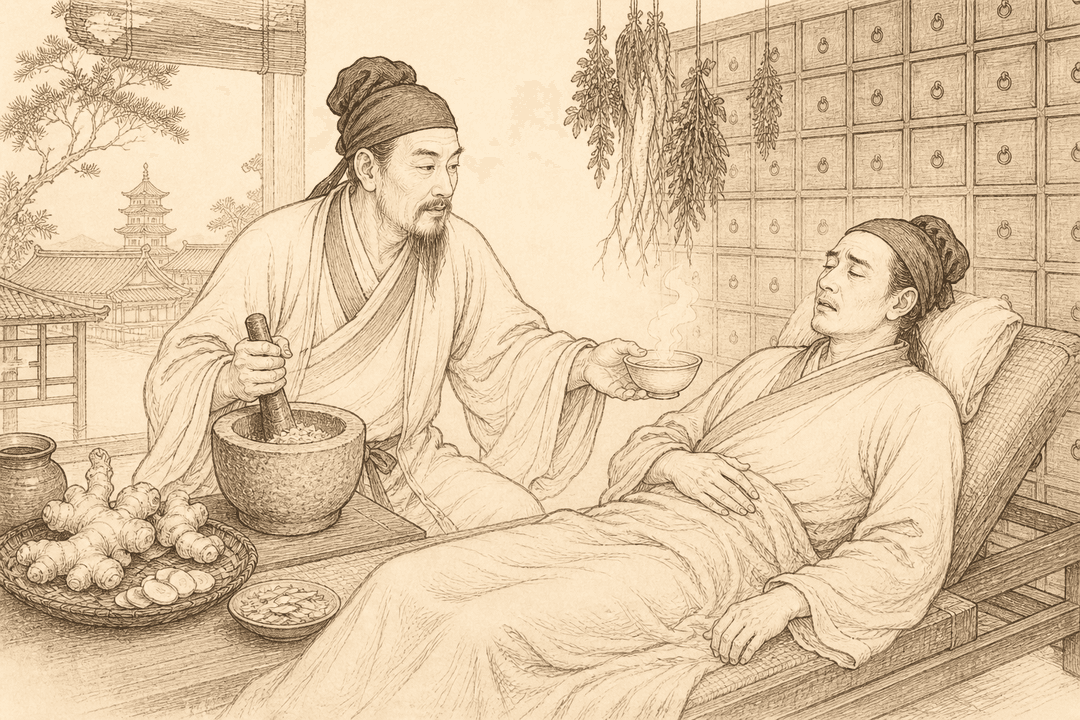
Ayurveda, reading the root independently, reached for its highest praise: fresh ginger is ardraka, dried ginger shunthi, and together they are vishwabheshaja, "the universal medicine", and mahaushadha, "the great medicine" — a warm remedy above all for the queasy gut [10]. And in the Greek world Dioscorides had already written the same conclusion [8]. Four traditions — Confucian, Chinese, Ayurvedic, Greco-Roman — one shared verdict: warm, pungent, and the surest thing there is for a turning stomach. Hold on to that. It is about to meet the laboratory.
The modern reading: gingerol, and the trials
The heat has a name: gingerol, chief of the pungent compounds in the fresh root. Dry the root and gingerol converts to shogaol, hotter and more penetrating — precisely why the old texts prized dried ginger (干姜) for a deeper warmth [11]. And what the laboratory found is what the physicians described: ginger's gingerols and shogaols act on the very 5-HT3 receptor that modern anti-nausea drugs are built to block, and they hurry the stomach's emptying — two mechanisms that together quiet a queasy gut [11]. Twenty-first-century pharmacology and Sun Simiao's line describe one thing.
The clinic bears it out. A meta-analysis pooling twelve trials and 1,278 pregnant women found roughly a gram of ginger a day significantly eased the nausea of early pregnancy, and safely [12] — which is why obstetric guidance, the American College of Obstetricians and Gynecologists' included, lists ginger as a genuine non-drug option for morning sickness [13]. In a trial of 576 cancer patients, ginger alongside standard medication reduced the acute nausea of chemotherapy [14]; and in the study that first caught the modern eye, powdered ginger outperformed a standard travel-sickness drug against seasickness in a spinning chair [15]. The scale is honest — a gentle remedy, not a miracle — but the direction is unmistakable, and it points straight back to the oldest text.
More than a settled stomach
The warmth the old physicians felt on the tongue turns out to be anti-inflammatory in the body. Gingerol dampens the same inflammatory pathways that everyday painkillers target — and in a rigorous trial of 261 patients with knee arthritis, a concentrated ginger extract eased their pain more than a placebo did [16]. The root the Compendium set down for cold and stagnation, the modern clinic files under inflammation. One warmth; two vocabularies.
The heat, read honestly
Ginger's pungency is not an accident of flavour; it is the medicine and the pleasure at once. It is why the warming root sits at the centre of the confinement kitchen across Singapore — teh halia and long-simmered ginger soups pressed on new mothers to settle the stomach and warm the body after birth — and why a few slices in hot water are still the first thing reached for when the stomach turns [17]. The oldest wisdom and the newest trial agree with the grandmother.
Read plainly, without either the mysticism or the megadose: ginger is warmth you can taste, a genuine friend to a queasy stomach, best taken as Confucius took it — as food, daily, and not to excess. That is the honest shape of it, and it has not changed in two and a half thousand years.
This is the root at the heart of our own bracing little pour, Ginger Shot — cold-pressed ginger, sharp and golden and warming, meant to be thrown back in one bright, fiery mouthful.
What we offer is only the pleasure of it: the clean burn, the warmth that blooms a moment later, the small daily ritual of the thing. Keep a few in the door of the fridge and let it be what ginger has always been — warm, pungent, quietly ancient — and a good reason to stop for a moment, first thing, and feel the heat of it before the day begins.


