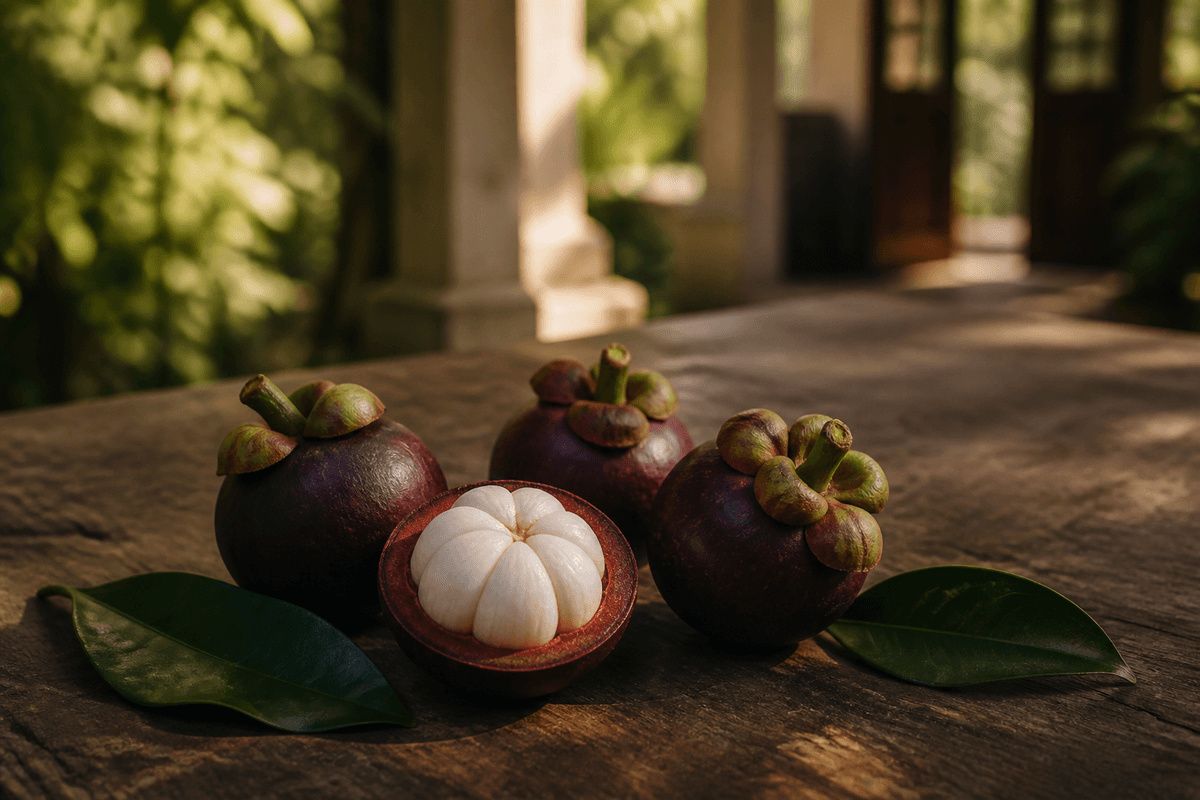
Cut a mangosteen the way everyone here learns to — a shallow score around its equator, a gentle twist — and it opens in your hands like a jewel box. The shell is thick and leathery, the deep aubergine of an old bruise, and it stains the fingers a stubborn ochre. Inside, against that darkness, sit five or six segments of flesh so white they look lit from within: soft, fragrant, sweet with a whisper of sourness, cool as sorbet [2][4].
That is the whole drama of the fruit, held in one hand — a bitter purple rind wrapped around a sweet white heart. Southeast Asia has always read the two halves separately. The flesh was pleasure, the thing kings and colonists and, in legend, a queen all wanted. The rind was medicine, the healer's half, and nobody's dessert. What follows is that fruit, opened along the line it grows: flesh and rind, the pleasure and the pharmacy, and why old practice and the modern laboratory quietly agree about where its power sits.
The queen who would not travel
The mangosteen (Garcinia mangostana) is a child of the wet equatorial belt — native to the Malay archipelago and the Sunda islands, the sweltering lowlands of what is now Indonesia, Malaysia and southern Thailand [1]. Its English name still carries its Malay one: manggis, softened by European tongues into mangostan, and then mangosteen [3].
Europe met it late and named it with care. When Linnaeus fixed the botanical name in the eighteenth century, he built the genus Garcinia in honour of Laurent Garcin, a French naturalist who had botanised through the Indies and published his own account of the "Mangoustan" in the Philosophical Transactions of 1733 [3].
But to name a fruit is not to own it, and the mangosteen refused to be owned. The tree is one of the slowest in the orchard — it can take the better part of a decade to bear its first fruit, tolerates neither cold nor drought, and once picked begins to spoil within days, the rind hardening, the flesh souring [4]. It is, in the horticulturist's word, non-climacteric: it will not ripen off the tree, so an unripe one shipped north simply arrives unripe, and rotting [4].
Stranger still, the queen needs no king. The mangosteen is functionally female — its flowers set fruit without pollination, and its seeds are not true seeds at all but clones of the mother tree, so that nearly every mangosteen on earth is the same ancient individual, copied and copied again [1]. A fruit that reproduces without sex, ripens only on the branch, and dies within a week of leaving it: small wonder that Europe, for centuries, mostly went without.
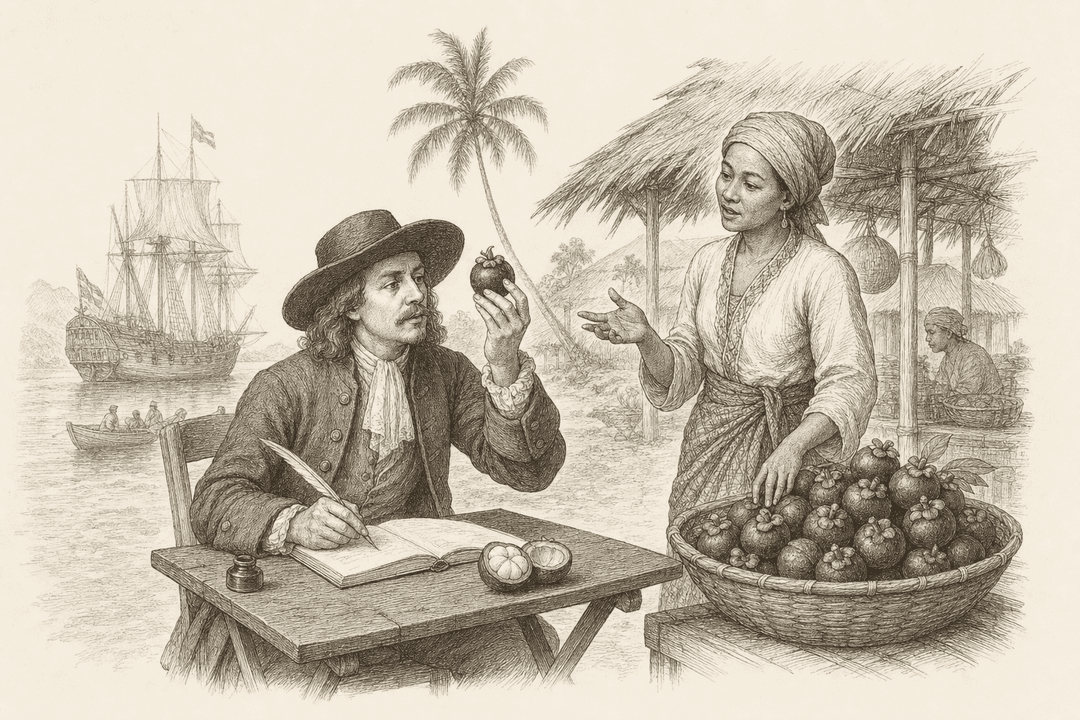
The first outsiders to know it well were the naturalists of the Dutch East India Company, sweating over their notebooks in the islands. Georg Eberhard Rumphius spent decades on Ambon in the Maluku compiling the Herbarium Amboinense — the first great European catalogue of these islands' plants, six volumes finished in blindness and published only after his death, between 1741 and 1750 [5]. Before him the Batavia physician Jacobus Bontius had already begun setting down the fruits and medicines of the Indies for readers who would never taste them [6]. To such men the mangosteen was a marvel worth crossing an ocean to describe.
A knighthood for a fruit
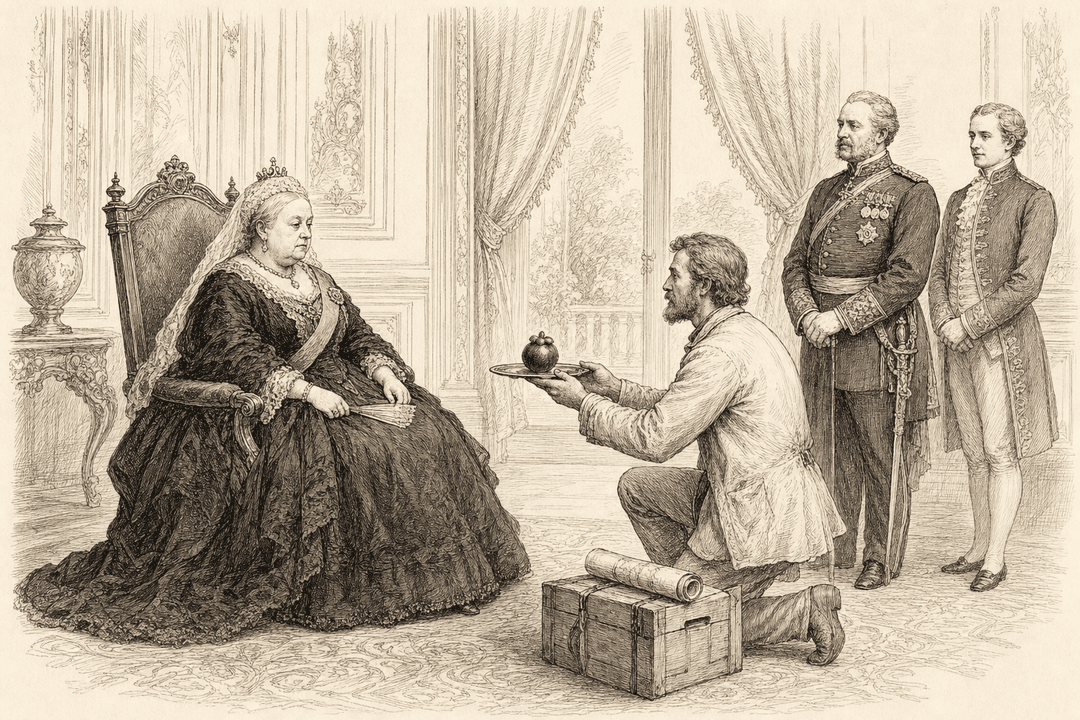
Distance breeds legend, and the mangosteen bred a good one. The story goes that Queen Victoria, having heard rapturous accounts of the fruit, offered a reward — a knighthood, in the fondest tellings — to whoever could deliver her a fresh one from the tropics. None could; it spoiled on every voyage.
Told honestly, it is a legend and little more. There is no documentary evidence that Victoria made any such offer; the tale seems to have surfaced as a rumour around 1890 and stuck because it was too charming to check [4]. What is true is the appetite beneath it. The American plant explorer David Fairchild, who tasted his first on Java in 1896 and spent a career trying to raise the tree in the United States, called the flesh "indescribably delicious" and counted it a favourite among the thousands of plants he introduced [4].
Whether or not a queen ever wanted one, the fruit kept her title. The mangosteen has been the Queen of Fruits for as long as anyone can remember — consort, in the Southeast Asian imagination, to the durian's King.
The healer's half
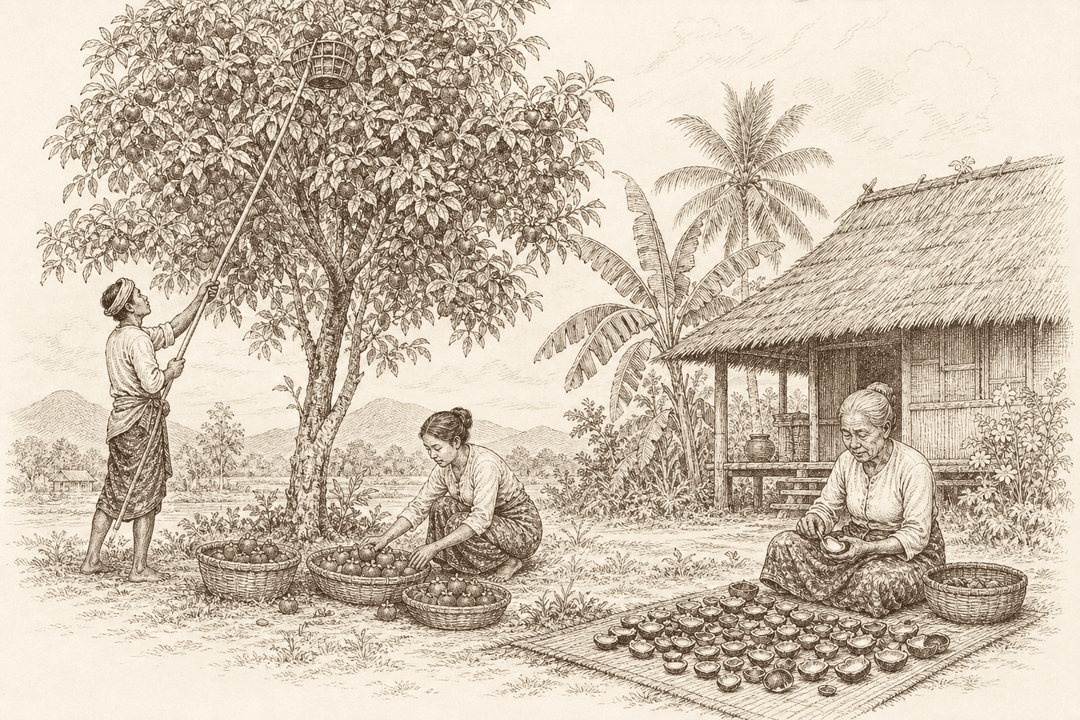
All of that is the flesh — the pleasure. The other half of the fruit tells a soberer story. Across Thailand, Malaysia and the wider region, traditional medicine reached not for the sweet white segments but for the bitter purple rind, dried and decocted into a dark, astringent tea [7][8]. It was given for dysentery and diarrhoea, and laid on wounds, skin infections and mouth ulcers — the rind, never the flesh, doing the work [8]. Rumphius and his fellow Company physicians recorded these uses as they found them, folk practice written down in Latin [5][7].
There is a plain reason the rind earned its place at the sickbed. The pericarp is dense with condensed tannins — the same astringent compounds that make an unripe persimmon pucker the mouth — and astringents tighten inflamed tissue and slow a loosened bowel [9]. The healers had no word for tannin. They had centuries of watching the rind do precisely what an astringent does.
The modern reading: xanthones, honestly
When chemists finally took the rind apart, they found more than tannin. The mangosteen pericarp is one of nature's richest sources of xanthones — a family of ringed compounds led by alpha-mangostin, first described from the fruit back in 1855 [10]. In the laboratory these xanthones are genuinely interesting: alpha-mangostin is a true antioxidant and a potent anti-inflammatory, quieting the NF-kB and MAPK signalling that drives inflammation, with promising results across a long list of disease models [10][11].
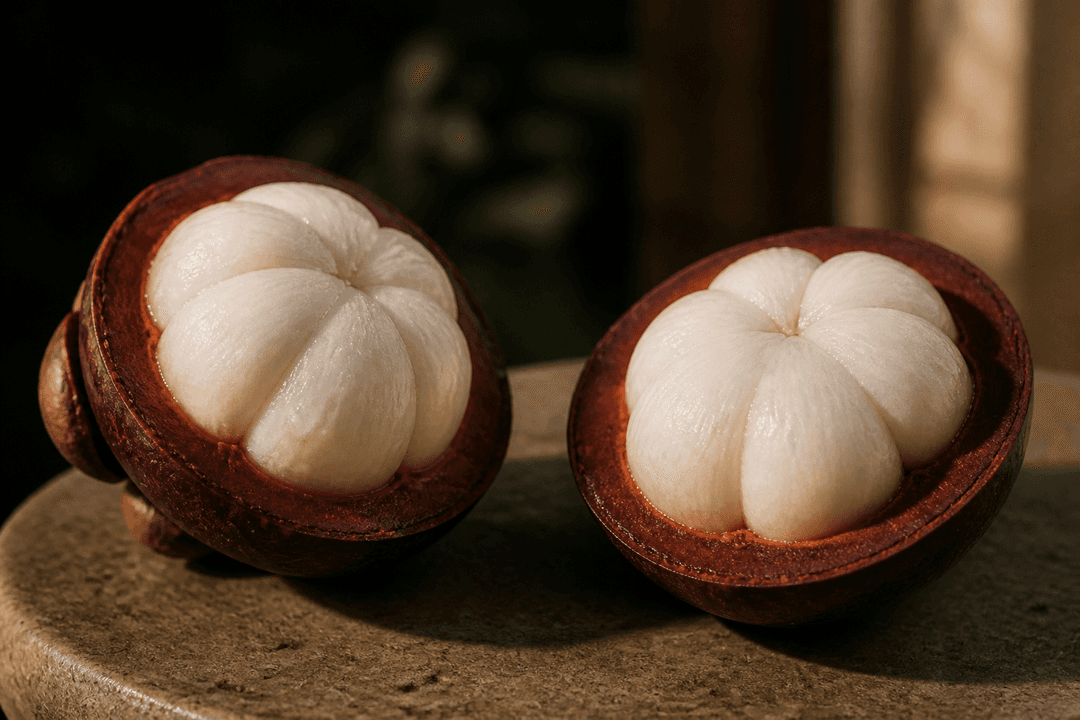
Here the two halves of the story meet. The healers used the rind; the chemists find the medicine in the rind — the xanthones live in that bitter shell, not in the sweet flesh we eat and press [8][10]. Old practice and new instrument, pointing at the same purple peel.
But authority means saying where the evidence stops. Almost all of that xanthone science is preclinical — cells and animals, not people; the well-designed human trials that would confirm a benefit in the body remain, honestly, thin on the ground [11]. The mangosteen is a real fruit with a real chemistry, not a proven cure. Which is exactly where its reputation went wrong.
The miracle-juice years
In 2002 a Utah company called XanGo began bottling mangosteen — rind puree and all — as a "superfruit" juice, sold through a multi-level marketing network. Within a few years it was a billion-dollar business, its sellers crediting the xanthones with easing everything from arthritis to cancer [12]. In 2006 the American regulator sent a warning letter: by promoting the juice against specific diseases, the company was marketing an unapproved drug [13].
It was the oldest error in the wellness playbook — take a genuine, modest, preclinical finding and inflate it into a miracle in a bottle. The queen never needed it. She had been sublime, and honestly used, for three hundred years before anyone thought to sell her as a cure.
The cooling foil to the king
In Singapore and up the peninsula, the mangosteen keeps older company. Durian and mangosteen ripen together, roughly June to August, and are eaten together by long custom: the durian is the King of Fruits, rich and warming — "heaty," in the local idiom — and the mangosteen is the cooling (凉) Queen brought in to balance him, yin set against the durian's yang [14].
There is, it should be said, no scientific proof that one fruit cancels the "heat" of the other; the likeliest reason they are eaten together is simply that they fall from the trees in the same weeks [14]. But the pairing is older than any nutrition label, and it endures because it is true to the senses — the durian heavy and custardy, the mangosteen clean and cold behind it, the perfect full stop to a rich thing.
Where this leaves the fruit
Read along the line it grows, the mangosteen makes a quiet kind of sense. The rind was always the medicine — astringent, xanthone-rich, the healer's half. The flesh was always the pleasure: sweet, cool, sublime, the thing a queen was said to want and could not have.
Our own mangosteen pour, Siam Mangosteen, is that second half and nothing more — the white flesh pressed cold, the pleasure the fruit was loved for long before anyone counted its compounds.
Keep a bottle in the door of the fridge for the warm months, when the durian sellers appear and the season turns purple. It is only what the mangosteen has always been on this side of the world: the cool, sweet Queen — best enjoyed slowly and, like the tree that bore her, never hurried.


