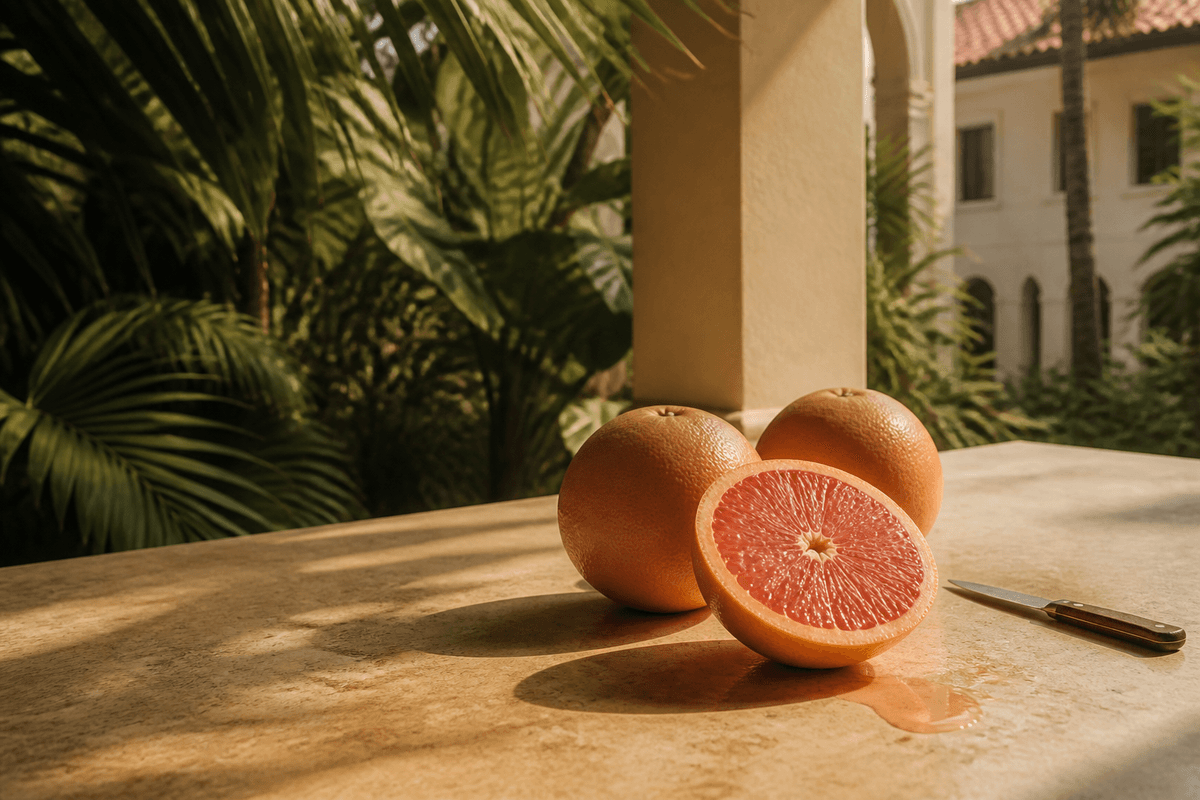
Halve a pink grapefruit and the scent arrives before the knife is through — sharp, faintly floral, with a bitterness underneath that no orange carries. The flesh is the colour of a held breath: rose at the rind, deepening to coral at the core, each segment beaded with juice. You taste it and something in you sits up. This is not a fruit that flatters. It is sour and bitter and sweet at once — the grown-up citrus, the one that asks a little more of you.
For all that composure, the grapefruit is an infant. Almost everything in the market carries a long human pedigree; this one does not. It is the youngest of the great citrus, an eighteenth-century accident — the chance child of two older fruits that met, unplanned, in a garden in Barbados. Its depth is entirely inherited. Read it two ways, and both are worth the time: through the thousand-year-old parent that lends it gravity, and through the modern laboratory that handed it the single most famous footnote any fruit can claim.
The youngest fruit in the room
Grapefruit (Citrus × paradisi) is a natural hybrid — a spontaneous cross between the pomelo (Citrus maxima) and the sweet orange, both of them Asian fruits carried to the Caribbean in the seventeenth century.[2][3] Neither parent is native to the New World; both were established in the West Indies by 1692, and somewhere among the warm gardens of Barbados they crossed on their own, without a gardener's hand.[2] The result was a fruit nobody had planned and nobody had seen: larger than an orange, bitter where its parents were sweet, hanging in heavy clusters. Everything cultured and ancient about grapefruit, it borrowed. In the long calendar of the things we eat, it was born yesterday.
A garden in Barbados, and a forbidden fruit
The story begins with the parent, arriving by an old sailor's route. According to Sir Hans Sloane's A Voyage to Jamaica (1707), a Captain Shaddock — an English commander trading out of the East Indies — left the seeds of the great Asian pomelo in Barbados as he passed through.[4] The seeds took. Across the English-speaking Caribbean the pomelo is called the shaddock to this day.[4]

Somewhere among those transplanted trees, a pomelo and a sweet orange crossed, and the grapefruit appeared — unbidden, in a planter's garden. The first person to write it down was a Welsh clergyman. The Reverend Griffith Hughes, rector of St Lucy's parish, spent his Barbados years cataloguing the island, and in The Natural History of Barbados (1750) he described a strange new citrus he called the forbidden fruit — a tree whose fruit, he wrote, exceeded "in the Delicacy of its Taste, the Fruit of every Tree in this or any of our neighbouring Islands."[1] It is the earliest known description of grapefruit anywhere.[1]
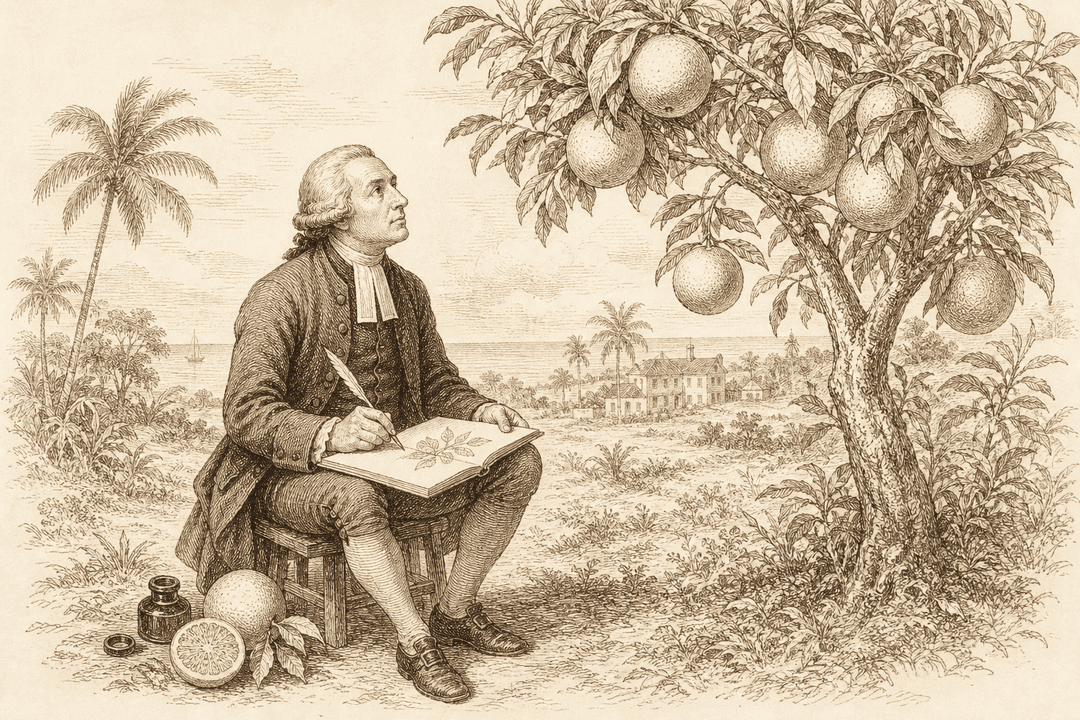
The friendlier name came later, and by accident too. In 1814 the Jamaican naturalist John Lunan printed the word grapefruit, remarking that the fruit hung in tight clusters, like an enormous bunch of grapes.[5] The name that stuck is a small botanical joke — a citrus the size of a fist, named for a grape.[5][2]
The ancient parent
Grapefruit has no old text of its own; it arrived too late for one. Its parent, though, is written deep into the record — and lends the young fruit its only real claim on antiquity. The pomelo — 柚 (yòu) in Chinese — has been prized in the East for well over a thousand years.
When Li Shizhen completed the Compendium of Materia Medica (本草綱目) in 1578 — the towering Ming pharmacopoeia, three decades in the making — he gave the pomelo its own entry among the fruits. He set it down as sour and cooling (酸, 寒), harmless, a fruit that "disperses food, resolves the toxin of wine, and clears foul qi from the stomach and gut" (消食, 解酒毒).[6] Five centuries before anyone had heard of an enzyme, the physician had read the citrus exactly right: a bitter, cooling thing that cuts through richness and settles a heavy table. Anyone who has reached for grapefruit after a long dinner knows precisely what he meant.
The pomelo at the full moon
In Singapore the pomelo's oldest meaning comes round each autumn. At the Mid-Autumn Festival, when the mooncakes are cut, a whole pomelo sits on the table — because 柚 (yòu) sounds like 佑, to bless and protect, and like 有, to have.[7] To eat pomelo under the full moon is to ask, in a pun a thousand years old, for blessing and abundance. Children wear the emptied rind as a hat — a small helmet of citrus — in the hope the moon will notice and grant the wish.[7]
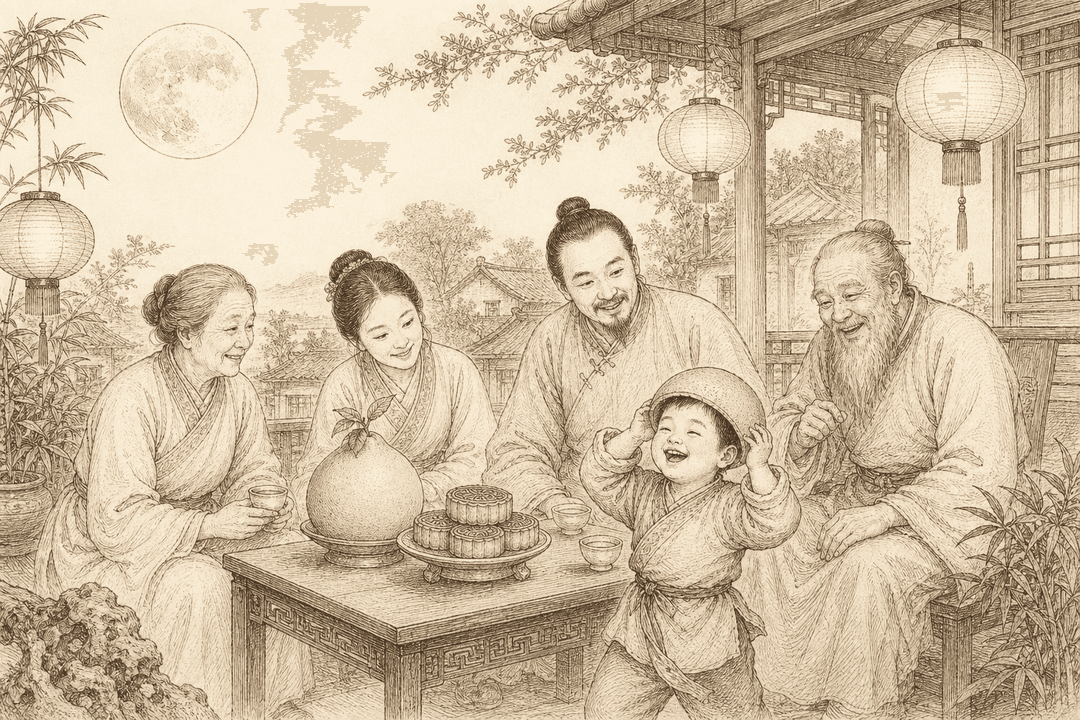
This is the lineage the grapefruit married into: a festival fruit, an offering, a thing set on the table to be honoured. The pink infant in the Barbados garden inherited all that gravity without ever having to earn it.
The reading modern medicine takes seriously
Here grapefruit steps out of its parent's shadow and does something no other fruit has managed — it earned a permanent place in the pharmacology textbook.
In 1989 a team in Ontario, led by the pharmacologist David Bailey, was testing a blood-pressure drug and used grapefruit juice to mask the taste of alcohol in the trial. The alcohol did nothing. The grapefruit did something startling: blood levels of the drug came back three times higher than the dose should have allowed.[8] Their report in The Lancet in 1991 opened with the admission that it was "a chance finding."[8]
The cause is a family of compounds called furanocoumarins, all but unique to grapefruit and its pomelo parent. They switch off an enzyme in the wall of the gut — CYP3A4 — whose task is to break certain medicines down before they reach the blood.[10][9] Disable it, and the body absorbs far more of a drug than the dose intends. The effect is not fleeting: the gut must rebuild the enzyme from scratch, so a single glass can matter for the better part of a day.[10] More than eighty-five medicines are now known to interact with grapefruit, and over forty of them can do serious harm.[9] It is the one fruit a pharmacist may ask you about by name — a genuine, grown-up footnote worth knowing if you take daily medication, and nothing to fear if you do not.
What it actually gives, honestly
Strip away the mythology and the fruit is still remarkable — just not in the way the twentieth century wished it to be. For decades grapefruit was sold as a slimming miracle, the sour centrepiece of the mid-century "grapefruit diet," as though the bitterness itself could melt away weight. It cannot, and never could. That is the fad we leave behind. The real fruit is the more interesting one.
Half a grapefruit carries roughly half a day's vitamin C.[12] Its bitterness is naringin, a flavonoid — the grown-up edge that no breeding has ever bred out, and the very thing a sweetened drink is designed to hide.[2] And the pink is lycopene, the same pigment that reddens tomatoes and watermelon; the deeper the flesh, the more of it, which is why the ruby varieties glow.[11] That colour is itself a young accident — the Ruby Red was found in 1929 as a single mutated branch on a tree in the Rio Grande Valley of Texas, and every pink grapefruit since descends from bud-sports like it.[11] A fruit all of two centuries old, still improvising.
Where this leaves the fruit
Grapefruit is not a superfood, and never asked to be. It is the youngest of the citrus — an accident with an ancient parent, bittersweet and faintly bitter, honest about exactly what it is. It carries a real pharmacological footnote most fruits would envy, a thousand-year Chinese pedigree it married into, and the double joke of a colour named for a pigment and a fruit named for a grape.
That contradiction is the whole pleasure of it. It is the citrus at the heart of our own blush-pink pour, Pink Haze — grapefruit pressed cold with pear, sour and sweet at once, the bitterness left honestly in. The forbidden fruit, on your table at last — and a good reason to slow down on a Sunday and look, for a moment, at the colour of it before you drink.


