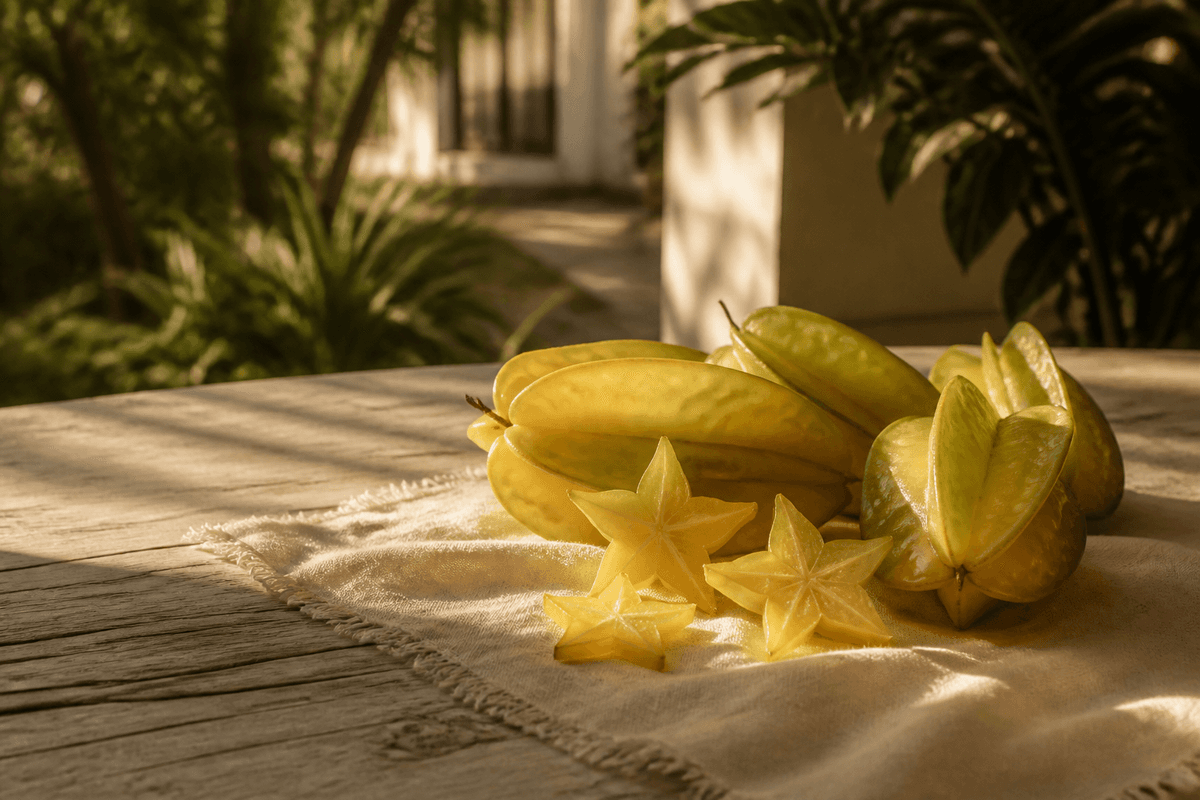
Slice a starfruit across the middle and it falls open into stars. Not a garnish trick, not a flourish of plating — the fruit is built that way, five green ridges running its length, so every clean cut is a five-pointed star, pale gold and lit from within. Nothing else in the wet market arrives already shaped like a small piece of good luck.
To know it properly, you hold it up to three lights. Two of them agree — the classical Chinese physician's, and the modern laboratory's — and both call it cool. The third is a warning. An honest fruit is the kind that tells you about it.
The tree in every kampong
The starfruit is native to tropical Southeast Asia — our own corner of the world — and has been grown here since long before anyone thought to write it down; like turmeric, it no longer grows truly wild, surviving only where people have carried and planted it [1]. In Singapore it is the belimbing manis, the sweet star, and for generations it was simply there: a tree in the kampong yard, over the back fence, in the corner of the school field, dropping far more fruit than any one household could eat [4].

It belongs to the wood-sorrel family (Oxalidaceae) — hold on to that name, it returns at the end. Its sour cousin, the bilimbi or belimbing asam, is the one Malay kitchens reach for to sharpen a fish curry or a sambal; the sweet star is the one you eat out of hand, drop into a rojak, or press into a cool, faintly floral juice [5].
There is a quiet grace note in its Latin name. When Linnaeus came to file the tree, he called the genus Averrhoa — after Averroes, the great twelfth-century Andalusian physician and philosopher [1]. A fruit of the equatorial tropics, catalogued forever under the name of a Mediterranean doctor: to European eyes, too, this was a plant that looked like medicine.

The Chinese reading: a coolant for heat and thirst
China has known the fruit for many centuries and read it, from the first, as a cooling thing. The early Records of the Plants and Trees of the Southern Regions (南方草木狀) set down its oldest name — the five-ribbed fruit, wu lian zi (五斂子) — describing a yellow, five-ridged fruit, crisp and intensely sour [3].

By 1578 the physician Li Shizhen had gathered the tradition into his Compendium of Materia Medica (本草綱目), the great pharmacopoeia of Chinese medicine, and his verdict on the fruit is four characters long and exact: it governs wind-heat, generates fluids, and stops thirst (主風熱,生津,止渴) [2]. Later practice added the throat — a fruit to clear heat and settle the voice, reached for against a raw throat and a dry cough (潤喉爽聲) [12].
Across the Malay world the same reading held, arrived at quite independently: carambola juice was a body coolant, pressed and drunk by anyone running a fever [4][5]. Hold on to that one word — cool. It is about to meet the laboratory.
The modern reading: mostly water, and vitamin C
The laboratory confirms the old verdict almost to the letter, because the coolness is not poetry — it is chemistry. A raw starfruit is around ninety-one per cent water, and carries only about thirty-one calories in a hundred grams: less sugar than almost any sweet fruit you can name [10]. To eat one is, quite literally, to drink something cool.
What little else it holds is worth having. That same hundred grams gives about thirty-four milligrams of vitamin C — better than a third of a day's worth — along with potassium and a set of plant antioxidants, gallic acid and quercetin and epicatechin among them, that lend the pale fruit more depth than its mild taste admits [9][10].
Set the two readings side by side. The Tang and Ming physicians called it cooling, thirst-quenching, throat-easing. The modern analysis calls it water, vitamin C, and a whisper of sugar. Centuries and a continent apart, they describe one fruit: a coolant, not a stimulant.
The star's one shadow
Now the third light — the one an honest portrait cannot leave out. Remember the wood-sorrel family. Its signature is oxalic acid, and the starfruit carries a great deal of it [1]. In most people, most of the time, that passes without event. But in large quantities, or in the wrong body, oxalate can crystallise in the kidneys [8].
There is a second, stranger hazard, and modern science did not manage to name it until 2013. A Brazilian research team, publishing in the journal Angewandte Chemie, isolated the compound behind what doctors call starfruit intoxication and named it caramboxin — an amino acid built much like phenylalanine, but one that reaches the brain and switches on the glutamate receptors that drive excitation [6]. In a person with healthy kidneys, caramboxin is filtered out and nothing happens. In a person whose kidneys are failing, it accumulates, crosses into the brain, and can bring on hiccups, confusion and seizures — at worst, death [6][7].
This is no rare-book footnote; it is a documented clinical danger. In one review of reported cases, the great majority of those poisoned already had impaired kidneys [7]. The rule that follows is simple, and worth stating plainly: for anyone with chronic kidney disease or on dialysis, starfruit — the fruit and its juice alike — is genuinely dangerous and best avoided altogether [11]. For everyone else, eaten as a fruit is eaten, it is exactly what it has always been.
The honest fruit
That warning is the whole reason to trust the rest. It would be easier to leave out — most fruit does not come with a caution, and the starfruit enjoyed a brief modern career as a miracle exotic, a wonder-fruit for the health-juice aisle. But the honest reading is the more interesting one, and by far the older.
The traditions were honest in their own fashion. They read the fruit as a medicine — cooling, for fevers and sore throats, taken in modest amounts for a purpose — never as something to swallow without thought. The laboratory only drew the caution in sharper lines and named the one group who must decline. Old and new agree on the gift, and, quietly, on the caveat.
That is the fruit we prefer: not the reheated superfruit fantasy, but the real thing — the humble kampong star, cool and clean and forthright, caveats and all. Nature tested by time rarely oversells itself. Go to the source, read it plainly, and it tells you the truth.
The star, read whole
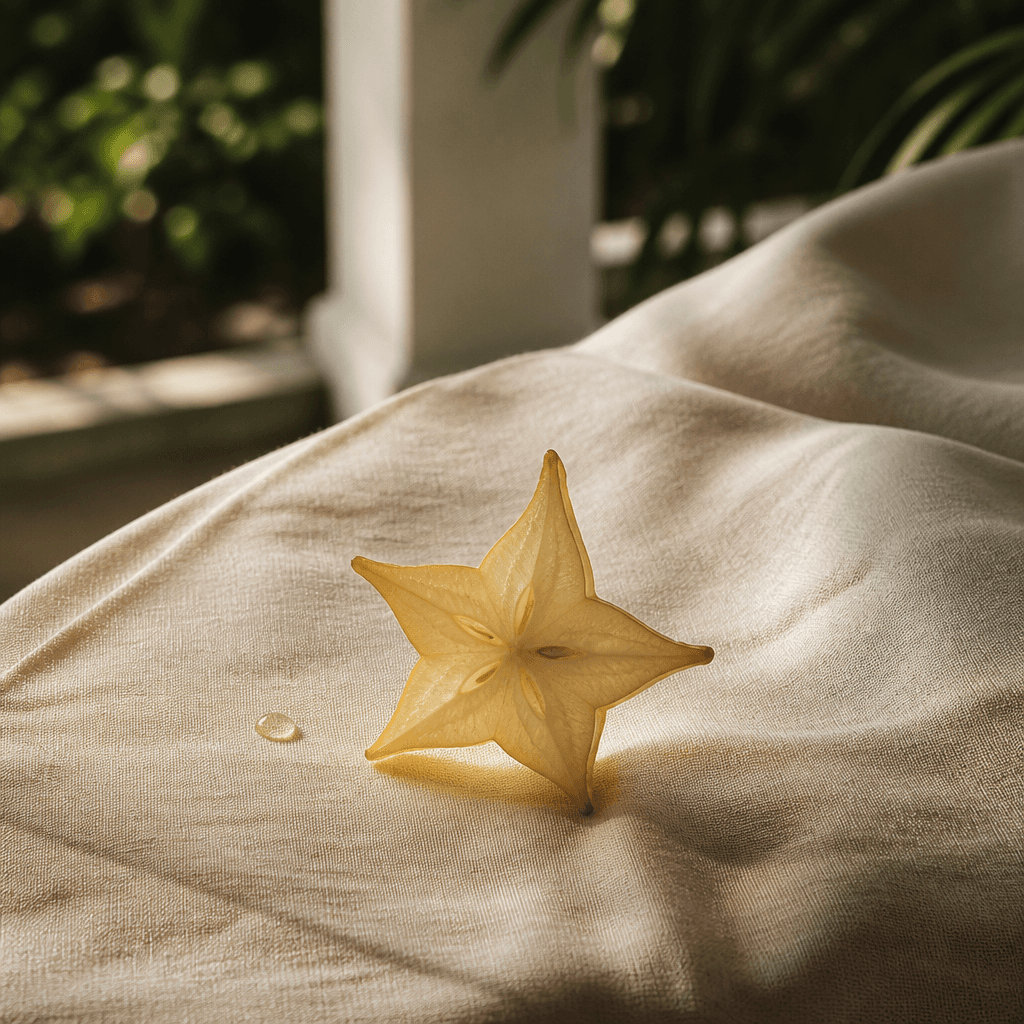
Hold it up to all three lights and the picture is complete. A fruit shaped like a small piece of luck, almost entirely cool water and a little vitamin C, read as a coolant by physicians five centuries apart — and honest enough to name the few it is not for.
This is the fruit at the heart of our own pale-gold pour, Kampong Star — starfruit pressed cold with pineapple, clean and faintly floral, the quietest bottle we make.
What we offer is only the pleasure of it: the cold, the pale gold, the first clean and faintly floral sip. Keep one in the door of the fridge and let it be what the starfruit has always been on this island — cool, clean, and honestly itself — and a good reason to slow down on a Sunday, cut one open, and watch it fall into stars.


