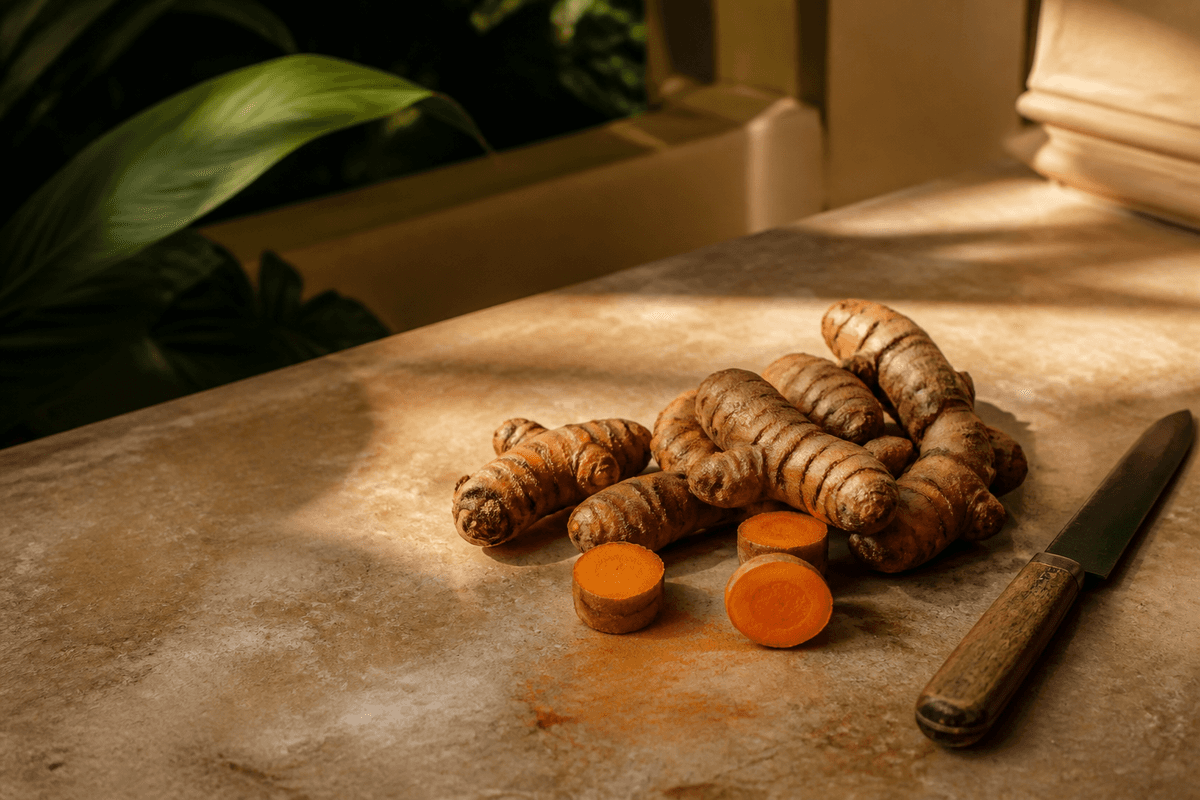
Grate a knuckle of fresh turmeric and it stains on contact. The gold climbs the fingernails, settles into the grain of the board, tints the cloth a yellow that will not fully wash out. It has dyed monks' robes and brides' skin and the inside of ten thousand curries. Nothing else in the market announces itself in quite this colour.
Turmeric is the dried rhizome of Curcuma longa, a plant so long in human hands that it no longer grows wild anywhere on earth — every root traces back to one a grower chose, propagated not by seed but by cutting [1]. For four thousand years it has been read as several things at once: spice, dye, cosmetic, medicine, blessing. What follows is that root, held up to three lights — the Ayurvedic physician's, the classical Chinese pharmacist's, and the modern laboratory's. They agree more than you would think.
The oldest gold in the kitchen
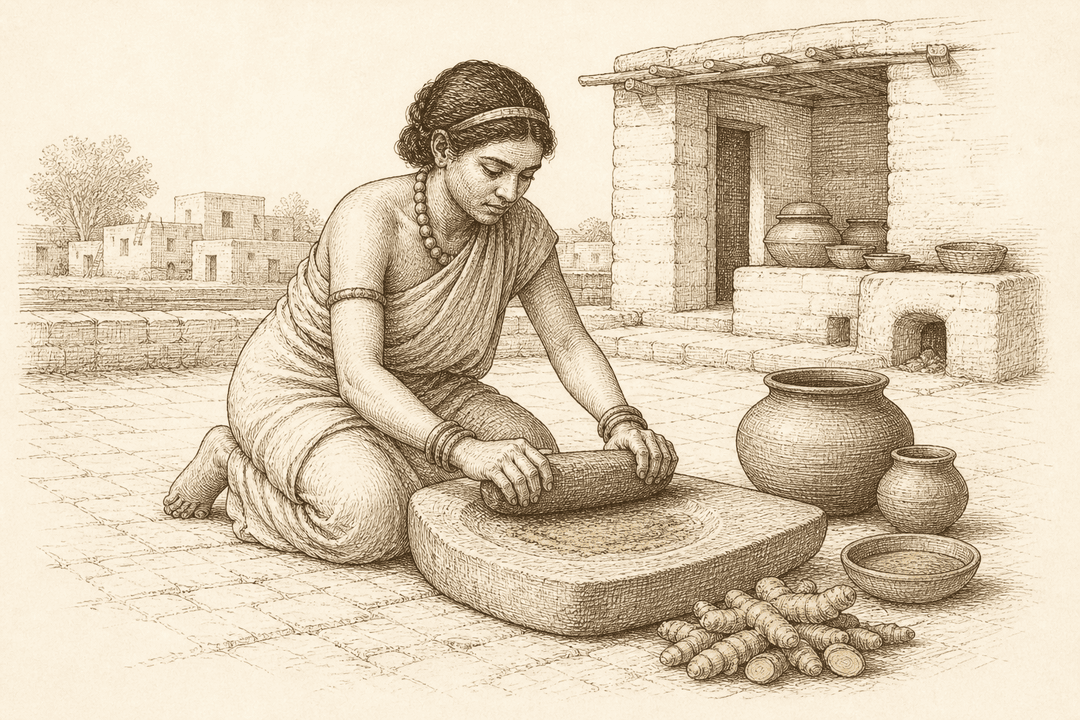
Turmeric belongs to the ginger family, and to the Indian subcontinent, where it has been grown and ground for at least four millennia [2]. The evidence is literal: at Farmana, a Harappan settlement north-west of Delhi, archaeologists recovered turmeric residue from cooking pots and from the tartar on ancient teeth, placing the spice in Indus Valley kitchens around 2500 BCE — among the oldest culinary traces we have of anyone, anywhere [3].
From that heartland it travelled. When Marco Polo reached southern China around 1280 he found it thriving, and wrote — with a merchant's eye for a substitute — of "a vegetable that has all the properties of true saffron, as well as the smell and the colour, and yet it is not really saffron" [2]. Medieval Europe agreed and called it Indian saffron: the affordable stand-in for the world's dearest spice, and a far more generous dye [2]. India still grows roughly four-fifths of the world's turmeric today [1].
A dye for gods and weddings
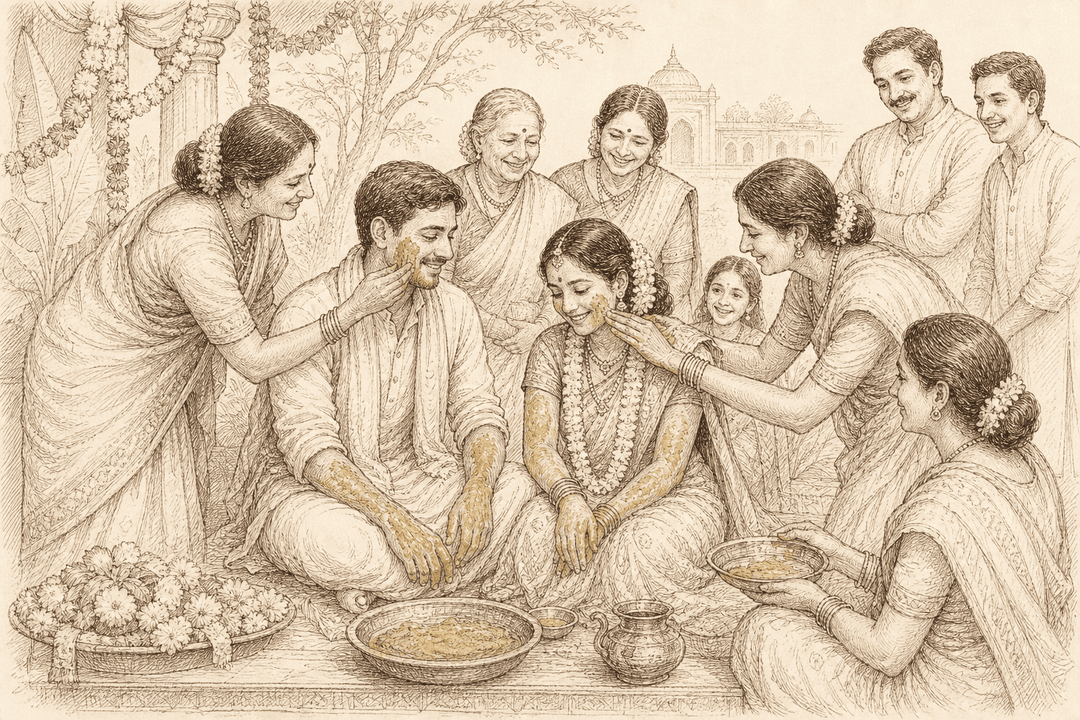
Long before it was a medicine, turmeric was sacred — and it was sacred because of the colour. In Hindu tradition its gold is auspicious, the shade of the rising sun and of prosperity, and it sits at the heart of the haldi ceremony: in the days before a wedding, the families anoint the bride and groom with turmeric paste, to bless the skin and turn away the evil eye [14].
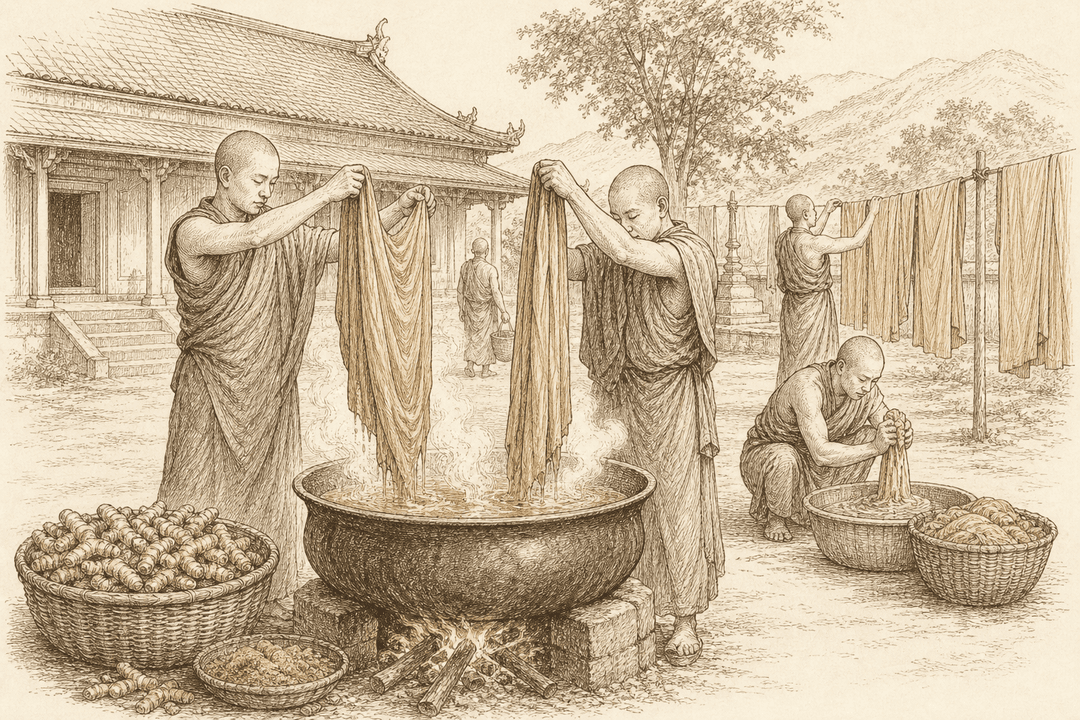
The same gold clothed the region's monks. The saffron robes of the Theravada Buddhist world — the kāṣāya — were dyed with whatever the forest gave, and turmeric was among the first; the famous saffron robe is very often a turmeric one [13].
And it settled, in time, in our own corner of the world. In the Malay kitchen turmeric is kunyit — the soul of rendang, of nasi kunyit, of the fish curries — and the bright root of jamu kunyit asam, the turmeric-and-tamarind tonic grandmothers across the region have pressed and drunk for generations [15]. Long before a golden latte reached any café menu here, the golden drink was already ours.
The Ayurvedic reading: haridra, the golden healer
The oldest written verdict on turmeric is Ayurveda's. In Sanskrit it is haridra (हरिद्रा), and the classical texts read it by taste and warmth: bitter and pungent (tikta, katu), light and drying, and — the crucial note — heating in potency (ushna vīrya) [4].
That warmth put it to work. Charaka's compendium files haridra among the herbs that scrape stagnation, mend the skin and clear infestation; Sushruta, the surgeon, dressed wounds with a paste of it [4]. Above all it was varnya — a giver of complexion, reached for to bring skin clear and luminous [4]. The bride's paste and the physician's poultice are, in the end, the same idea.
The Chinese reading: a warm mover of blood
China met turmeric later, and read it independently — arriving, remarkably, at almost the same place. The spice enters the official record in the Tang dynasty's Newly Revised Materia Medica of 659 [6], and in 1578 the physician Li Shizhen gathered the tradition into his Compendium of Materia Medica (本草綱目), the great pharmacopoeia of Chinese medicine [5].
His reading is exact. Turmeric (姜黄) is pungent, bitter and warming; it "sends the qi down and breaks the blood," disperses swelling, and — the line worth holding — treats wind-damp pain of the arm (治風痺臂痛) [5]. Li Shizhen even untangles an old confusion between three near-identical golden roots: turmeric enters the spleen and governs the qi, its cousin yujin (郁金) enters the heart and moves the blood — and sliced turmeric, he adds, "can enter the arm to treat pain" [5].
One honest wrinkle, to the tradition's credit: an early source had called turmeric profoundly cooling, and the Tang physician Chen Cangqi corrected it flatly — to call it greatly cold is a mistake; it is more bitter than pungent, and warm, not cold [5]. A living tradition, checking its own record. Hold on to that word — warm, and for pain in the joints. It is about to meet the laboratory.
The modern reading: curcumin, and an honest catch
The gold has a name: curcumin, chief of the pigments called curcuminoids, which make up only a few per cent of the dried root [7][8]. It was first drawn out in 1815, its structure settled a century later [7].
What the laboratory found is what the old physicians described. Curcumin blocks NF-κB — the master switch that turns on the body's inflammation [9]. And the clinic bears it out where it counts: in a rigorous 2014 trial, 367 patients with knee osteoarthritis took either ibuprofen or a turmeric extract for four weeks, and the turmeric eased their pain and stiffness just as well as the drug [12]. A remedy for aching joints — precisely the arm pain the Compendium set down four centuries earlier.
Here, though, is the honest catch the fad glosses over. Swallowed on its own, curcumin is barely absorbed: poorly taken up, quickly broken down, quickly gone [9]. The chemists who know the molecule best are blunter still — isolated curcumin is unstable, reactive and non-bioavailable, and no rigorous placebo-controlled trial of the pure compound has ever succeeded [11]. The supplement aisle's answer is to megadose a single extracted molecule. The traditions had a wiser one.
What every kitchen knew about pepper
The wiser answer was pepper. Add a little black pepper to turmeric and its compound piperine raises curcumin's absorption by around two thousand per cent [9][10]. Fat helps too — which is why turmeric has always lived in oil-rich curries and warm milk.
Now look back with that in mind. Ayurveda's warm turmeric milk, haldi doodh, is finished with pepper; the Malay tonic pairs kunyit with sour tamarind and ginger; the curry simmers the root in coconut and ghee. Every kitchen that used turmeric seriously wrapped it in exactly what the laboratory would later find it needs. The science did not discover how to use turmeric; it explained why the old way worked.
The colour, and the gold from within
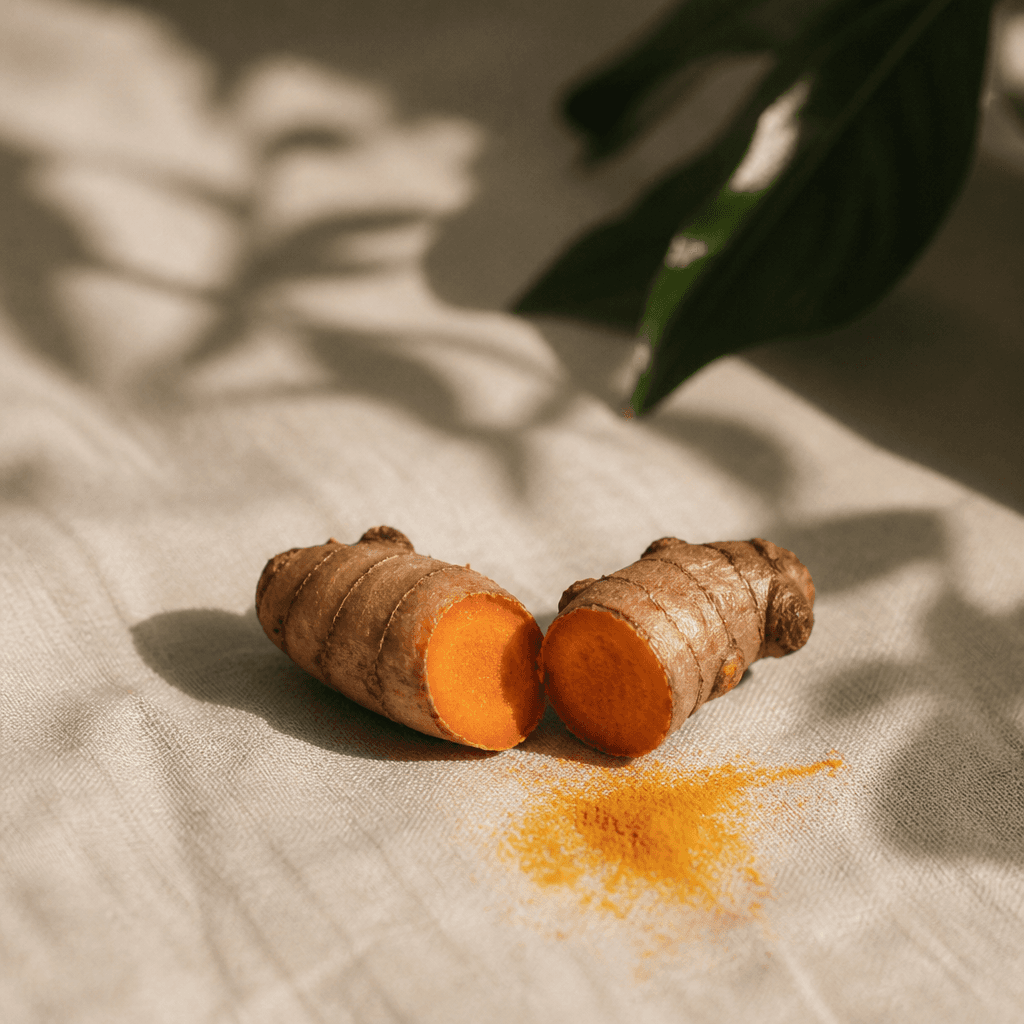
That impossible yellow is not only a flavour; it is one of nature's most useful dyes, listed by the food industry as E100 and lent to everything from mustard to butter [1]. It is a quiet chemist, too: turmeric-stained paper turns red in the presence of alkali, an indicator trick children and laboratories have both enjoyed. The root that colours a robe colours a test strip.
And it returns us to skin. Ayurveda called turmeric varnya and laid it on the face for millennia [4]; the modern cosmetic literature files it under the very same heading, a traditional brightening agent now studied in its own right [8]. Read plainly, without the halo: "glow from within" is an old idea turmeric has carried since the first bride wore it — not a new claim, but a very old one.
Where this leaves the root
Three traditions, four thousand years and half a world apart, read turmeric and came back with a single answer. Ayurveda read its warmth; the Compendium read its nature; the laboratory read its chemistry — and all three called it a warm, gold remedy for pain, swelling and skin. The colour was the clue the whole time.
This is the root at the heart of our own golden pour, Turmeric Glow — turmeric pressed cold with pineapple and orange, warm and faintly peppery, the citrus carrying it home.
What we offer is only the pleasure of it: the deep gold in the glass, the way the colour slows a room down, the first cool, bright sip. Keep one in the door of the fridge and let it be what turmeric has always been — warm, golden, quietly ancient — and a good reason to stop on a Sunday and look, for a moment, at the colour of it before you drink.


