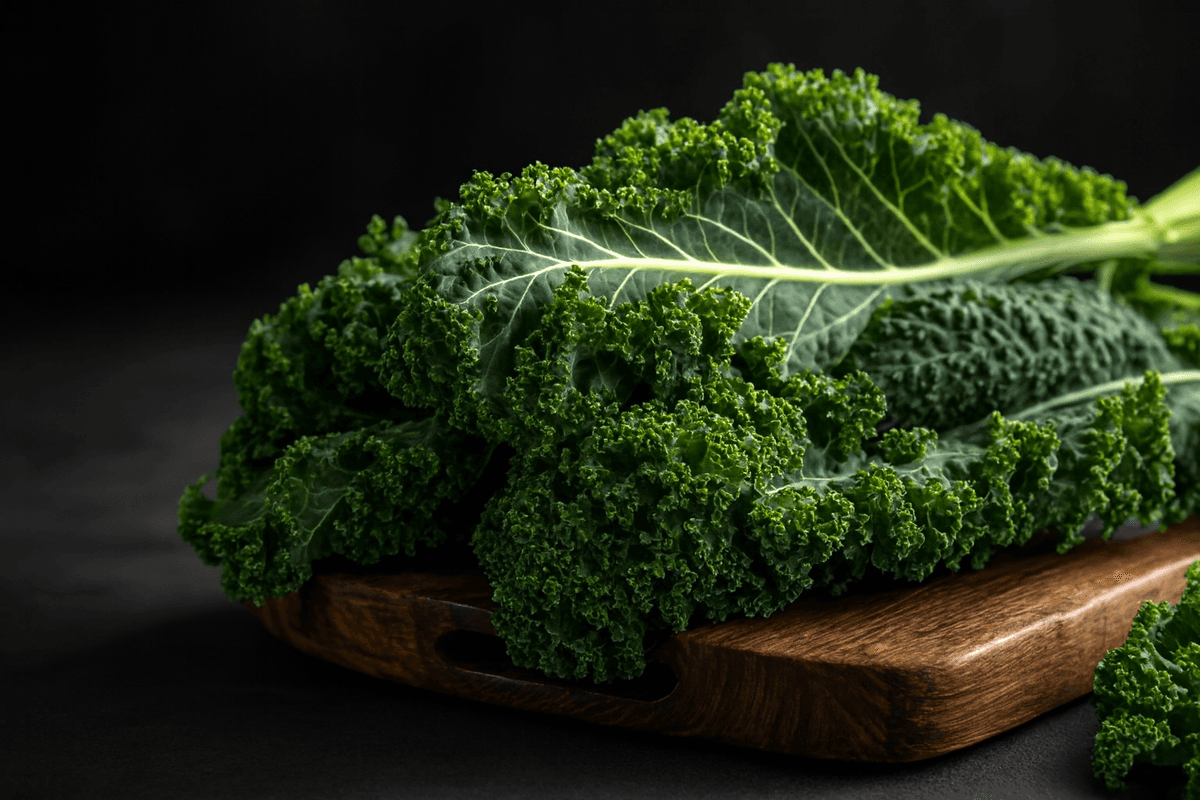
Leave a kale plant standing when the first frost has flattened everything else in the bed, and it will not merely survive — it will taste better for the cold. The leaf comes up blue-green and crimped, waxed against the weather, sweeter after a hard night than it ever was in the warmth. Almost nothing else in the garden does this.
Kale is Brassica oleracea — and so, remarkably, are cabbage, broccoli, cauliflower, Brussels sprouts, kohlrabi and Singapore's own kai lan. One wild species, coaxed by two and a half thousand years of human hands into a dozen vegetables that look nothing alike [1]. Kale is the one that stayed closest to the original: the plant before the plant. What follows is that leaf, held up to two lights — the ancient kitchen that lived on it, and the modern laboratory that arrived late to measure it. They agree more than you would think.
One wild plant, a whole tribe
The ancestor still grows wild. On the limestone sea cliffs of Atlantic and Mediterranean Europe, the wild cabbage clings where little else will — salt-tolerant, wind-hardened, its leaves thickened to hoard water on an exposed ledge [1]. Genetic sequencing places kale as the closest of all the cultivated coles to that wild original [2]: less a bred novelty than the wild plant lightly tamed.
The names remember it. Kale, cole, collard, kohlrabi — all descend from the Latin caulis, meaning stalk or stem, the word that in time replaced brassica as the everyday term for cabbage across half of Europe: German Kohl, Scots kail, Dutch kool [3]. And the tribe reaches all the way to our own table. The kai lan (芥藍) in a plate of oyster-sauce greens is Brassica oleracea too — a Chinese kale, the same species by another name, drawn out of the same wild plant an ocean away [4].
The most praised plant in the ancient garden
The classical world was, frankly, besotted with the cole. It ate the open, leafy kind — closer to kale than to the tight modern head, which came later — and treated the plant as food and medicine at once.
Cato the Elder, writing the oldest surviving work of Latin prose around 160 BCE, was unequivocal: "It is the cabbage which surpasses all other vegetables" [5]. He prescribed it for the digestion, praised it as a laxative, and left one gloriously practical instruction for a Roman dinner party — eat raw cabbage dressed with vinegar before you sit down, and a few more leaves after, and, in his words, "you can drink as much as you please" [5].
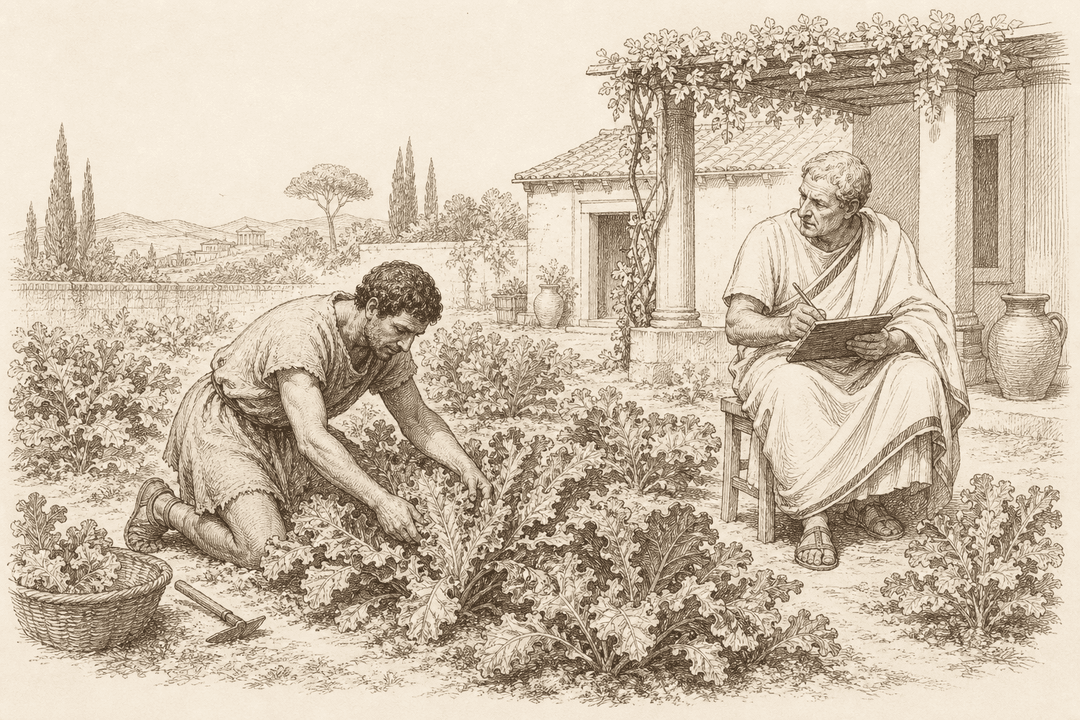
Pliny the Elder, a little over two centuries later, all but threw up his hands at the size of the subject: "it would be a long task," he wrote, "to set forth the praises of the cabbage" [6]. He noted that the physician Chrysippus had devoted an entire volume to the plant alone — organised, extraordinarily, according to its effect on each separate part of the human body — and that Pythagoras and Cato had sung its virtues no less lavishly [6]. A whole book, on one leaf. That is the ancient reading in a sentence: not a garnish, but a near-panacea you happened to grow beside the kitchen door.
The green that outlasted winter
When the heading cabbage and its plumper cousins were bred into being, the old loose-leaf cole did not disappear. It went north, and it stayed — because it could do the one thing the tender vegetables could not. It survived the winter.
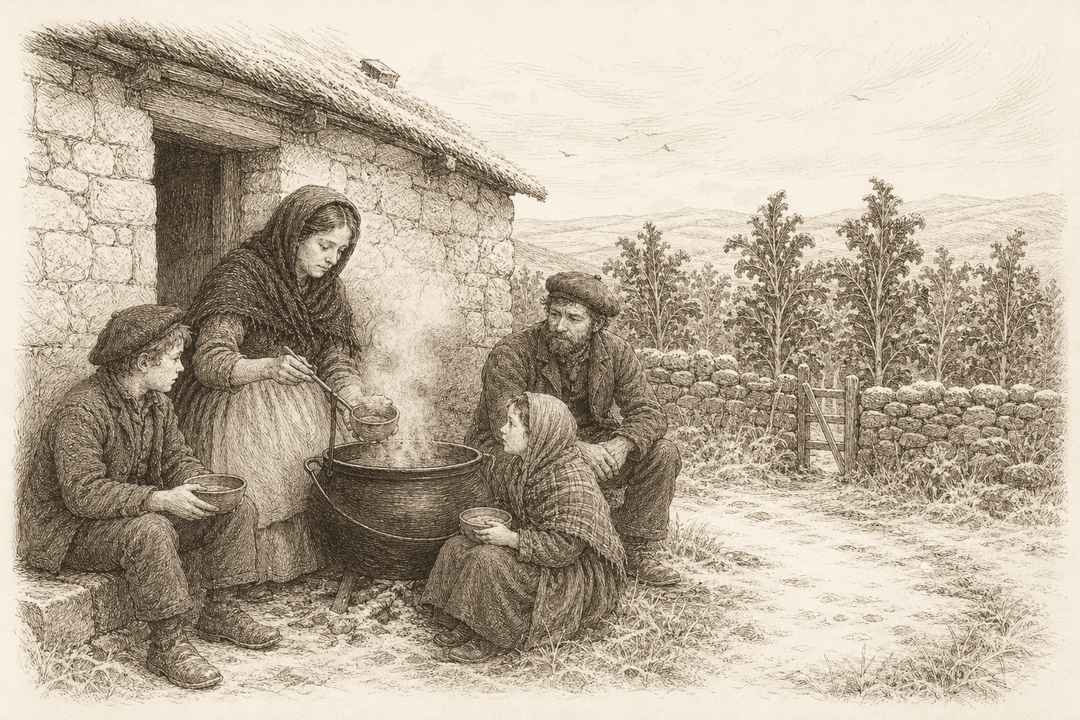
Nowhere took it more to heart than Scotland. The kitchen garden itself was named for the plant — the kaleyard — and kail became the Scots word not only for the green but for dinner, for the pot it simmered in, for the meal entire [7]. Seedlings were raised in low stone-walled beds against the gales, then set out to stand through the dark months and be cut from November to spring [8]. The crofters knew, without needing to know why, to wait for the cold: the sweetest kale came after frost [8].
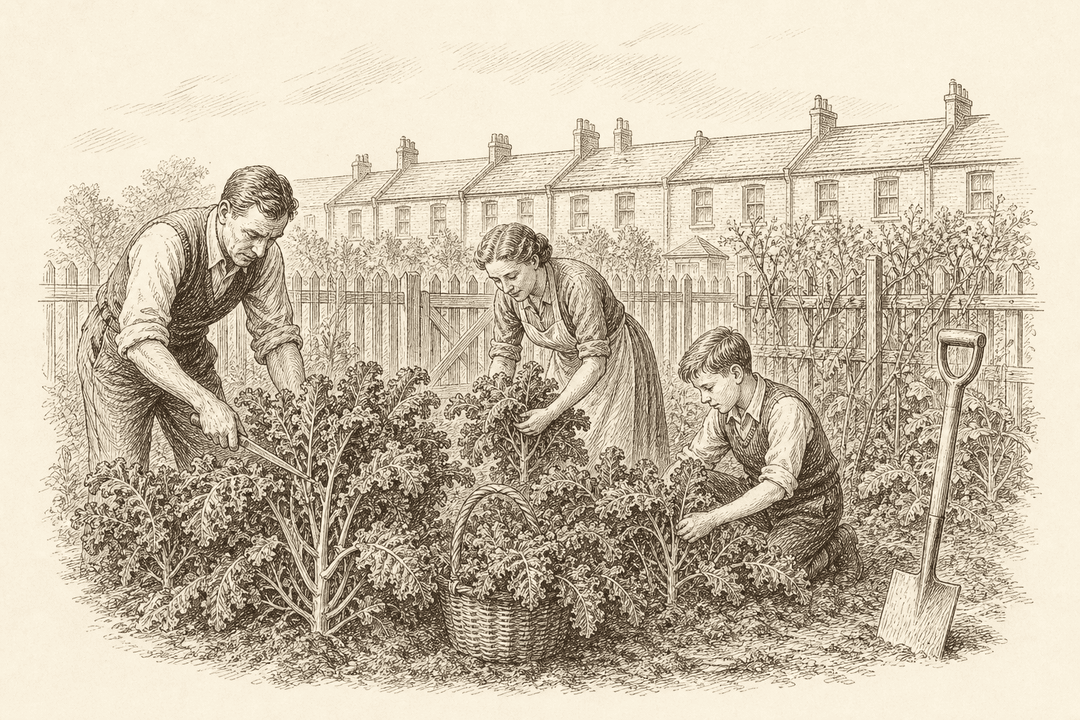
The habit outlived the crofts. When Britain dug up its lawns and its parks to feed itself through the Second World War — the Dig for Victory years, when the nation's allotments swelled from around 815,000 to nearly a million and a half [11] — the official growing guides leaned on the hardy brassicas, kale foremost among them, to carry the household through the "hungry gap" of late winter, when little else stood in the ground [10]. Once again it was exactly what it had always been: the green that kept people fed when nothing else would.
The frost had a reason
That old instruction — wait for the frost — turns out to be exact chemistry, and it is where the two readings of kale first meet.
When the cold comes, the plant defends itself much as we salt a road. It converts the starch in its leaves into sugars, which lower the freezing point of the water in its cells and hold off the ice crystals that would rupture them [9]. The kale is not sweeter by accident; it is sweeter because it is surviving. The crofter tasted the result five centuries before anyone could name the mechanism — and reached, as the old traditions so often did, the right conclusion by way of the wrong theory.
What the laboratory found
Held to the modern light, kale is simply one of the most nutrient-dense things a garden grows. A single ordinary serving carries several times an adult's daily vitamin K, along with generous measures of vitamins A and C [12].
Its quiet distinction, though, is in the eye. Kale is among the very richest dietary sources of lutein and zeaxanthin — and those two pigments are the only carotenoids the body draws out of food and concentrates in the retina itself, packing them into the macula as a yellow filter that shields the eye from light and is associated with protection against age-related decline [13]. The plant makes them yellow to guard its own leaf; the eye borrows them for precisely the same purpose. It is a rare, almost literal case of becoming what you eat.
Then there is the family chemistry. Like all its cousins, kale carries glucosinolates — sulphur compounds that, the moment the leaf is chopped or chewed, an enzyme converts into isothiocyanates such as sulforaphane, the most studied of them [14]. Sulforaphane is why the whole brassica clan is watched so closely by cancer researchers. Here, though, is the honest note the fad skipped over: most of that promise still rests on cell and animal work, the richest source is in fact the young broccoli sprout rather than kale, and robust human trials remain thinner than the headlines suggested [14][15]. The compound is genuine and interesting. It is not yet a miracle — and kale is far better understood as a dense whole food than as a delivery device for one molecule.
The superfood that was never a fad
Which brings us to the strangest chapter. For years the largest single buyer of kale in America was, reportedly, Pizza Hut — which used it not as food at all, but as the frilly green garnish lining its salad bars [17]. Then, around 2011, a canny publicist invented a fictional "American Kale Association" to talk the leaf onto New York menus; by 2012 a food magazine had crowned the "Year of Kale," and by 2014 the word was printed across a pop star's sweatshirt and sold as the front line of the cleanse [16]. A two-thousand-year-old survival food became, briefly, a marketing campaign.
The fad has since cooled, which is the best thing that could have happened to it. What remains when the hype burns off is the far more interesting plant beneath it: ancient, humble, frost-sweetened, the wild cabbage barely tamed — good, as the old physicians insisted, for very nearly every part of you, and needing no association, fictional or otherwise, to vouch for it.
Where this leaves the leaf
Two readings, two thousand years apart, arrive at the same unfussy verdict. The ancient kitchen prized the cole as an everyday near-medicine and learned to wait for the frost; the laboratory measured its density, found the eye's own pigment sitting in the leaf, and explained the sweetness. Neither reading needed the word superfood. The plant was always enough.
This is the green at the heart of our own cool pour, Green Reset — kale pressed cold with orange, pear and a squeeze of lemon, the citrus and soft fruit carrying the leaf home.
What we offer is only the pleasure of it: the clean green colour, the cold, the faintly mineral first sip. Keep one in the door of the fridge and let kale be what it has been for two thousand winters — the plainest, hardiest, most quietly generous green there is — and a good reason to slow down on a Sunday and taste, for a moment, the oldest leaf in the garden.


